Showing posts with label Havana. Show all posts

Two Years in the Life


1939: Winter audition for Major Bowles Original Radio Amateur Hour, at Ed Sullivan Theater. Buyú, Julio Andino and Ruben Berrios, piano, two brothers on guitars. I managed the band (with rhumba shirt); clavero. No luck. Tried at Chin Lee’s Restaurant, near the Latin Quarter Night Club. No luck. No money.

1939: Went with Julio to meet Machito at the Half Moon (one flight up, Broadway and West 81st Street), after aforementioned audition for Major Bowles. Passed out from rum. Julio put me in the subway, Fort Hamilton local to the last stop.

1939: Met Katherine Dunham dancers and Jack Cole dancers and hung out at the Cuban Village amusement area, New York World’s Fair. As an understudy, I learned el diabolito and la mula and el sacraficio, Nanigo dances. I was fired for shooting dice in the dressing room.

1939: At the Café Latino, Greenwich Village, shot crap with Buyú in the cellar (now called One If By Land, Two If By Sea, an expensive restaurant).

1939: Met Nino “the Great” Yacovino. Joined his troupe, three couples. Worked at the Rhumba Casino at West-End, Long Branch, New Jersey. Did solo with my partner, Gloria Cook (“Cookie” was Al Jolson’s mistress). Have photos and clippings. Joined La Playa Dance Troupe and worked the Wonder Bar on Woodward Avenue in Detroit (great show town!). Met Raoul and Eva Reyes there. Cugat at the Statler Hotel in Detroit, on tour. Frank Sinatra was at Ross Fenton Farms in New Jersey.

1939: Stayed at the Kingsley Arms Hotel, Asbury Park, NJ, where I had my studio in the solarium and taught Rhumba.

1940–41: Received wire to go to Miami Beach to join Cuban Troupe, three couples, plus Pepito and Carmen at the Carrousel Club cum revolving bar, featuring the craze: La Conga! Taught dancers around Miami Beach hotels, in my own studios: Bali Club, Hotel National off Lincoln Road, and at the Tatem Surf Club (exclusive Christian “No Jews” policy). Also at Coral Gables Country Club (restricted). Orchestra Ina Ray Hutton, all-girl orquesta. Attended University of Miami; exchange scholarship to University of Havana.

A Dancer Is Born

Singers want to be actors and actors want to be dancers, but none of them want to be prize fighter. But prize fighters make good dancers. With their speed, balance, endurance and courage, they are unequaled in performance before the public. Millions of dollars are paid to witness them in action and millions are wagered on the outcomes.

I was taught to dance by a prize fighter named Nino “The Great” Yacavino, but also how to be my best in managing my life with an emphasis on performance.

We were always attracted to prize fighters while growing up. All I had to do was look out my bedroom window to watch matches presented by the Bay Ridge Boxing Association, with the ring set up on the tennis court grounds that in the winter were used as a skating rink. I had a free ringside set to watch graceful boxers, ice skaters and tennis players.

My mother, who used to dance in her red dress on the top of a table at family gatherings, was a fight fan who in summer vacationed at Tony Cammonari’s training camp in the Catskills, and who took me to see Prima Carnera on stage at Loew’s Sheridan in the Village, where we lived while growing up. My dad, on the other hand, was less interested in pugilism and the fight crowd. Mom was a tough cookie, a fighter who beat the Great Depression.

Nino Yacavino was a Brooklyn fighter who wanted something better for himself than a brutal beating. He and his wife and sister-in-law organized a dance troupe that included a Latin dance teacher and his partner, and needed only one other member for his tall sister-in-law. My height got me the job, not my dancing ability, since I couldn’t even do the fox trot and had difficulty finding patent leather shoes to fit me. What I did have was a familiarity with Latin music and the rhythms of the 1938 Casino de la Playa orchestra from Havana.

Being tall for my age at 18, I tended to slouch so that when Nino contacted me, the first thing he did was teach me how to walk across the room balancing a book on my head. Since his nightclub date was fast approaching, he and his wife soon had me doing the box step and learning our routines, which included rumba, bolero and samba. To learn more, I went to the Park Plaza, where the best Latin dance team in America, Rene and Estela, taught me more basic movements so that a dancer was born!

During the ‘30s, the boxing profession was Mafia, as was horseracing and many of the nightclubs with “cut liquor,” betting parlors and gambling rooms. Nino may or may not have been involved with the Mafia but he did succeed where others failed by getting us a full summer’s gig at the Rumba Casino in West End, Long Branch, New Jersey. The place was perhaps a gambling joint but well concealed from us. It was owned by Jimmy Pellechia, boxing commissioner of New Jersey, who later served time for mortgage fraud (see the Daily News, 1938). When the club signed up a troupe called the China de Simone Dancers, there was among the girls Gloria Cook, an ex-mistress of Al Jolson with whom I did a duo act with fast rumba and lifts. When Jimmy Pellechia fell in love with my partner Gloria, he gallantly offered me a dance studio in the solarium of the Kingsley Arms Hotel in Asbury Park, which he owned. Food and board were on him for the balance of the summer season on the Jersey shore, since he broke up my act by taking Gloria to Hawaii.

Then, back in New York City, I teamed up with a dance student at Davalos Dance Studio on Broadway and 50th Street, and found myself in a Latin troupe formed by Davalos, for a performance at the Beacon Theater upstate in Beacon, New York. This led to my hanging around the Cuban Village at New York’s 1939 World’s Fair, as an understudy for the troupe that had been hired there. Whenever free, I frequented all the Latin dance spots around town: the Audubon Ballroom, the Park Plaza, the Masonic Lodge on 106th Street, the Caborojeno Workers Circle, Ben Mardes’ Riviera Club, and the more elegant nightspots such as Havana-Madrid, Versailles, Martinique and Embassy, until I was called to join Bob Conrad’s La Playa Dancers, booked into the Wonder Bar in Detroit in winter, 1939. Xavier Cugat was playing at the Statler Hotel there at the time.

My next gig was to be at the Carrousel Club in Miami, where I opened two dance studios at the new National Hotel and the Royal York in 1940, as well as at the exclusive Tatum Surf Club. While attending the University of Miami, I was working nights at the Coral Gables Country Club. It was in 1940 that I first visited Havana for a weekend, then again to attend the University of Havana in 1941 [see the blog entry “An Afro-Cuban Blessing”].

While in the military during the war, I performed Latin dance for US troops in the Philippines, then returned to the US to teach Latin at Grossinger’s Hotel with the Tony and Lucille Colon Dance Studio, along with Mike Terrace and Johnny Lucchese. In 1948, I began a long career on cruise ships as cruise director. Wherever travel took me, I spoke, danced and taught conga, bolero, rumba (fast and slow), plus the beguine and the merengue, samba, tango, pachanga, mambo (“Mambo #5” was a nation-wide hit and made Perez Prado famous) and the Mexican waltz—but still stumbled over a fox trot!

Prize fights and nightclubs during the early 1940s were gang-controlled turf that exposed me to people such as Santo Trafficante in Cuba, who invited me to be a “shill” with the tourists I escorted. I asked Bugsy Siegel for permission to dance with Virginia Hill, his gal, at the Beachcomber in Miami Beach. I asked Skinny D’Amato if he knew Jimmy Pellechia, the ex-boxing commissioner of New Jersey, jailed for fraud. The Musicians Union boss Petrillo may not have been “mob,” but I shook his pinky as he demanded.

My second nightclub gig was at the Carrousel Club in 1941. It was bankrolled with some of the money belonging to champion fighter Lou Tendler from Philadelphia. The Wonder Bar in Detroit, a city riddled with unemployed ex-Prohibition mobsters, was “mob,” as was the gambling joint called Club Bali in Miami, where I lost my paycheck every week. The 1939 Rhumba Casino, as we’ve seen, was Jimmy Pellechia’s, whose mob ties and gambling debts put him behind bars.

At the MGM, Las Vegas, in 1976, I ran into a friend, Wingy Gruber, the one-armed greeter from my old Club Bali days, not to mention from the crowds at the Tropicana in Havana. In the ‘70s, the cruise industry became big-time casino business, and I quit just as I could have made my knowledge pay off. Perhaps the African gods, the orishas, were talking to me about justice and the little man.

Fighters make good dancers, but dancers don’t make good fighters, as the following incident explains. One night at the Rhumba Casino, Nino Yacavino suffered a sudden appendicitis attack. He was throwing up bile and perspiring profusely. He pushed us away when we tried to restrain him from going out on the floor to perform. Coming off stage, he went to the hospital, semiconscious.

This was something Nino couldn’t teach me: how to be a true trouper, an average fighter who gets up off the floor to be a prize fighter, like my mom—who I taught to dance the mambo.

An Afro-Cuban Blessing

Havana, 1941

In a wooden shed that was mostly an altar of some sort, with much of the open sky for a roof, lived the most highly respected Santero in all of Cuba. He lived among a jumbled botanica of wax flowers, unrelated plaster saints of various sizes, and framed deities. Small sacks with secret contents were handing from the trees…. In short, I found myself visiting an authentic sanctuary in a spiritual jungle. Nevertheless, I felt strangely at ease in this unlikely garden, in this absurd theater, in this unfamiliar makeshift environment.

All this had actually begun a few nights earlier, when after an all-night party, I had left Miami for Havana to study at the University of Havana with Professor Bustamonte. On the way to the Hotel Inglaterra with my hangover, I kept my eyes shut against the Cuban sun. Being siesta, the empty streets seemed uninteresting. Once in my room, I fell onto the bed and into the arms of Morfeo. Around seven o’clock, I was slowly awakened by an approaching musical alarm. From the balcony window came sounds from the street. Unaccustomed to balconies, I grasped the railing to steady myself. Down below ran a river of colored lanterns gyrating among ruffle-skirted and ruffle-shirted dancers. With ceremonious authority, a parade of intensely disciplined congueros passed by as if in review. When the spectators below stood on their chairs, no doubt the highlight of the spectacle was approaching. Los Dandys de Belen were strutting by, New Orleans–style, with tails, spats, twirling canes and top hats. “Sient’ un bongo, mamita me’ta llamando, sient’ un bongo…”

I had arrived in Havana, unaware that it was Carnival. This was not mere touristic, theatrical display. Imagine my amazement. This was more than theme floats and majorettes…this was serious universal harmony…the splendor of a joyous humanity. The fireworks were in the eyes of these people. Where did the individual begin and the rhythm begin, since they were one? Overcome, and like an espantaneo, I ran down and plunged into the delirium of it all, falling in step with the elegant/primitive fantasy. I had gone from a stupor that hot afternoon, arriving in Havana for the first time, to the sobering sudden discovery of one of life’s true amazements: a bounteous gaiety ready to be shared with the whole world. Like winning the lottery of felicity.

Several days later, I mentioned casually to a student friend that I had been having difficulty reading Dr. Fernando Ortiz and Orifiche. I was struggling with the Lukumi vocabulary and negligible Spanish. He suggested crossing over to Regla to meet Juan Beson. There may still be people who remember this most influential babalao, with his tall, thin noble stance and his solitary front tooth that, like a badge, evinced a certain sincerity.

“What is he up to?” I wondered, as I stood back watching him light some candles. “He is invoking La Virgen de Regla, asking for protection for your house,” said my friend. The babalao was responding to the answer I had given him when he asked me, “Why have you come here?” (This is the same question a psychologist asks a new patient.) I was unprepared with a reply and with Ñañigo proverbs traveling Quixote-like around my brain, I was about to confess that it was not my intention to come…that my friend had suggested it…when I stammered…“la…la música.”

At that moment, the night surrounding us seemed to physically withdraw itself in respectful silence. From this tableau of a babalao, a young American and his Cuban friend, a trinity emerged like three magi in a holy night. As I received his blessing, I felt that he knew very well why I had come to Regla. “You will carry this music around the world,” he said. Was this a prophesy, or a command of sorts? Was it an example of his psychic insight? Whatever the meaning, it has influenced me all my life…of that there is no doubt. Knowing absolutely nothing of the technicalities of music, but now much imbued with the workings of its mysterious power. Was I to go forth like a neophyte apostle, an evangelist proselytizer?

Much shaken by this truly religious experience, I wondered: Was his odd statement merely an example of lyrical rhetoric? And example of pastoral eloquence, an embellishment of a ritual, a divinely inspired assignment? A fortuitous indoctrination, a revelation that made me a propagator of this music? A step toward my greater spiritual education, a sacred covenant, an oracular portent? An inescapable aesthetic responsibility that made me involved, indebted, privileged? A canonization witnessed by invisible Orishas, an unexpected imposition that made me an instrument of the music itself? Was the santero a channeler between Yemaya and a new convert?

After this encounter, one fact emerges from the overall picture of my life. I can see that I have faithfully “carried the music around the world.” Returning from Cuba in 1941, I opened dance studios all along Miami Beach; performed with the La Playa Dancers around the United States; exhibited rumba with the USO in Samar, Phillipines; run the Champagne Dance Contests aboard cruise ships; lead the immensely popular conga lines of the 1950s; taught with Tony and Lucille Colon at Grossinger’s; lectured oral history of the music at the Smithsonian; and donated my poster collection of Latin orchestras to Boys Harbor. I was given a dream in Regla that today I see slowly materializing into reality, like a plant I have watered. Surely we make the world a better place with this happy music…a duty that is set before all mankind…is it not? So it was foretold that I would one day write this for you to read.

“Blessed is he who has found his work.” —Thomas Carlyle

Some Stories Behind the Music

Most Anglos' knowledge of la musica Latina begins with Desi Arnaz and ends with Tito Puente, with little in between. Yes, perhaps Perez Prado, called the Father of Mambo, but how about Papote, Papaito, Perico, Paquito, Patato or Pupi? Anglos know B. B. King and “Jelly Roll Blues,” but how many of them know Miguelito Valdez, or that Cab Calloway imitated Miguelito’s authentic Nañigo ritualistic chanting, turning it into a gibberish called “Heidi, Heidi Ho” that made a mockery of an authentic Afro incantation? It made Calloway a millionaire, with no thanks or acknowledgement to Valdez.


One can learn to dance salsa easily enough, but where does one acquire the ability to discuss the merits of Manny Oquendo y Libre versus Larry Harlow, as Nashville does with their numerous Country Western stars, or talk about Marc Anthony and José José or the greatness of Celia Cruz?

To fully feel the music, one must know the players. Imagine enjoying your rock and roll and never knowing anything about Elvis. That is the sorry state of the Latin music scene as it concerns the Anglo adherents. Information gained concerning the music you are listening to or dancing to makes one a skilled player in the conversation setting as well as on the dance floor. Max Salazar’s Mambo Kingdom is an excellent source book along with The Latin Tinge, but more of the same is needed, especially in the popular press, on the Internet or in the living room.

The following encounters with the music and the individuals involved as experienced by an outsider, an Anglo like yourself, can bring this remarkable music into your life and give you el alma creola.

Anglos might know the “Watermelon Man,” Ramon “Mongo” Santamaria, but how many have heard of Candido (Julian Cabrera), who at age 87 is still beating conga around the world?

I first heard Candido at the Kursal club in Old Havana. It was sixty years ago while I attended the University of Havana and steered tourists around the many hot spots for pocket money. We took them to the Teatro Shanghai to see the stage show that openly featured the big star (porno), Superman, a household name.

We had mojitos at La Zaragozana for lunch, rum añejo before dinner at Sloppy Joe’s, Scotch and sexy super-spectaculars at La Tropicana and a late morning dip in the pool at the Hotel Nacional. When the Tropicana show began, gamblers returned to their tables, a problem for the house, that has since been remedied in Las Vegas by separating both activities into “rooms” that share charge admissions

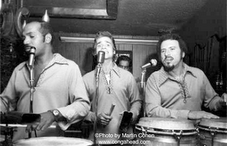
Spanish names like Rodriguez make for a blended, extended “family” made more confusing by the tendency to add somewhat of a clarification in the form of “pet names.” For example, Candido Cabrera is not to be confused with Candido, the timbale player named José Rodriguez, or bongoceros using “bongo” as a middle appellation such as Bobby Romero and Harry (Bongo) Rodriguez. The greatest in my opinion and in that of many others was the extraordinary bongocero José Mangual Sr., who adopted Buyú as his stage name.


I first met Buyú in 1937 at the Café Latino on Grove Street in the Village, and was at his bedside toward the end at Mother Cabrini Hospital seventy years later. Until that meeting, the only “Spanish Music” I knew was “La Cucaracha” and “Alla en el Rancho Grande.” When Buyú beat on what some people called bongos (“tom toms”) and maracas (“rattlers”), I went searching for the real thing. I traveled from Fort Hamilton across Manhattan and up into the Bronx to the Cabarojeño Workers Circle to hear it. Closer to home was the Park Palace on 110th and Fifth Avenue. It was there that I met Julio Andino in 1937.