Showing posts with label Julio Andino. Show all posts

Two Years in the Life


1939: Winter audition for Major Bowles Original Radio Amateur Hour, at Ed Sullivan Theater. Buyú, Julio Andino and Ruben Berrios, piano, two brothers on guitars. I managed the band (with rhumba shirt); clavero. No luck. Tried at Chin Lee’s Restaurant, near the Latin Quarter Night Club. No luck. No money.

1939: Went with Julio to meet Machito at the Half Moon (one flight up, Broadway and West 81st Street), after aforementioned audition for Major Bowles. Passed out from rum. Julio put me in the subway, Fort Hamilton local to the last stop.

1939: Met Katherine Dunham dancers and Jack Cole dancers and hung out at the Cuban Village amusement area, New York World’s Fair. As an understudy, I learned el diabolito and la mula and el sacraficio, Nanigo dances. I was fired for shooting dice in the dressing room.

1939: At the Café Latino, Greenwich Village, shot crap with Buyú in the cellar (now called One If By Land, Two If By Sea, an expensive restaurant).

1939: Met Nino “the Great” Yacovino. Joined his troupe, three couples. Worked at the Rhumba Casino at West-End, Long Branch, New Jersey. Did solo with my partner, Gloria Cook (“Cookie” was Al Jolson’s mistress). Have photos and clippings. Joined La Playa Dance Troupe and worked the Wonder Bar on Woodward Avenue in Detroit (great show town!). Met Raoul and Eva Reyes there. Cugat at the Statler Hotel in Detroit, on tour. Frank Sinatra was at Ross Fenton Farms in New Jersey.

1939: Stayed at the Kingsley Arms Hotel, Asbury Park, NJ, where I had my studio in the solarium and taught Rhumba.

1940–41: Received wire to go to Miami Beach to join Cuban Troupe, three couples, plus Pepito and Carmen at the Carrousel Club cum revolving bar, featuring the craze: La Conga! Taught dancers around Miami Beach hotels, in my own studios: Bali Club, Hotel National off Lincoln Road, and at the Tatem Surf Club (exclusive Christian “No Jews” policy). Also at Coral Gables Country Club (restricted). Orchestra Ina Ray Hutton, all-girl orquesta. Attended University of Miami; exchange scholarship to University of Havana.

Eulogy for Julio

...part two of a tribute to Julio Andino

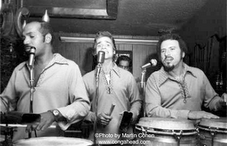
Before there was an Ernesto Antonio “Tito” Puente, there was Julio Andino. While Tito even has the 1979 Sugar Hill hip-hop to his many credits, Julio has no mention as a musician who brought the entire Latino music world before the public, the global public. While Tito introduced the xylophone’s power, and Cugat popularized rumba, Ignacio Piniero the son, and Arsenio the Afro-Cuban element, Julio brought into play a whole body of mainly repressed Latin music that was ignored while he himself was ignored.


Many give credit to Azpiazu’s “El Manisero,” but Julio did more than make people dance. He made them stop and listen and think and in doing so they heard the soul of the music calling to them. It was a sad, tough world of “no job, no heat, no hot water”—the years of the Great Depression that Julio navigated. It was one that Tito never knew the way Julio did. Tito is here forever while it is as though Julio never was, even though Tito, with admirable compassion in a heartless industry, was gratefully acknowledging Julio’s influence, an influence initiated by Julio that brought out the pride in Puerto Rican communities everywhere.


For forty years, Joe Conzo Jr. spoke for Tito as his manager while Julio was surrounded by those who would silence him. He never heard the screaming adherents that followed Tito, for himself; but he does have what Hindus consider sainthood. Like a mahatma, Julio was that one man alone who sent out the message of this music of the streets to the four corners of the world by prying open the door that closeted El Barrio musicians. He pioneered for them both the white and black dominated turfs of the late 1930s. He made possible the one trustworthy source of joy in a beset world—one that sings a child to sleep and one whose thunder and lightning can blow you away.


Tito’s popularity, for one, is Julio’s legacy.

Chinese Rhumba

When the old La Conga on West 51st Street became the China Doll overnight, the “rhumba-nik” crowd became quite concerned. Was their favorite club losing its Afro-Cuban flavor in favor of some Oriental concoction?

What happened was this: Beginning in early 1940, the Jewish community discovered chop suey, chow mein, egg foo yung, et cetera. They began to abandon Toffinetti’s Italian cuisine on Times Square in favor of Ruby Foo’s Chinese cuisine. Ruby Foo’s itself was inspired by an unknown upstairs restaurant crowded with customers at 49th and Broadway. The place was called Chin Lee’s.

Lucky Mr. Lee had a gold mine. It was not in the same order as other Chinese restaurants operating at that time. His offered a “revue,” with “no cover, no minimum.” He gave customers free tea refills unlimited and the free fortune cookie gimmick. His matchbooks published prices for a general public that mistrusted nightclub price tactics; he portrayed his establishment in this way as being forthright and honest-dealing. His matchbooks stated: Lunch. 40¢. Dinner. 80¢, except Saturday evenings. Lunch, Saturdays and holidays. 45¢. After-theater supper. 85¢. Wholesale and retail. For your health and good food. Use Chin Lee coupon books for free meal. With Chin Lee's list of twenty or thirty choices on an exotic menu, big servings of steaming hot or sour, mild or spicy rice dishes, using cheap labor and an amateur hula-hula girl revue, it was clear to Mr. Harris that his La Conga had to do something.

Chin Lee’s restaurant came to life at the end of the Great Depression’s baked beans and chili bill of fare at Horn and Hardart’s automat. He was a breath of fresh air. Furthermore, Mr. Harris saw Lee opening a second spot called Chin’s at 44th and Broadway, lit up with enormous Chinese lanterns. Even Ruby Foo’s had opened a second larger place down in South Beach, Florida, for the winter crowd. Chinese restaurants around the city were installing entertainment, finding that music and dining went well together, like corned beef and cabbage.

When it became clear that the Jewish public—comprising the majority of La Conga’s music-loving clientele—and Chinese food had discovered each other, Mr. Harris was forced to save his place by giving birth to the China Doll, if only in name. He boldly advertised it as “New York’s only Chinese nightclub,” with “shows at 8, 12 and 2:30” and “never a cover charge”—omitting reference to a minimum. “Deluxe dinners from $2.50,” giving his address as “East of Broadway,” rather than West 51st Street.

His menu was still steaks and chops, but without the Latin rice and beans plates. He had difficulty finding English-speaking help among the Chinese, and Orientals couldn’t mix drinks at the bar. Chinese food filled you and later you were still hungry—people still came to the China Doll now to dance to Machito or Noro Morales, but not to eat. Harris tried putting acts like the José Greco Dancers that broke away from the strictly Afro-Cubans…acrobats, Mexican, flamenco and Los Chaveles de España.

One night after the last couple left, he and I sat at the bar with only the bar lights on—to save electricity, I surmise. It was a somber moment even with the conga craze in full swing all over the country. He poured us double shots of his strongest rum and added, “Here’s a drink you can’t get—.” He never spoke the words “Chinese restaurants.” (The sudden growth of “Chinese” can be compared to the pizza phenomenon of the 1970s.)

He toyed with the idea of broadcasting nightly, using top personalities of stage, screen and radio, or giving free conga lessons, but his competition was getting stronger day by day. The Chinese were winning the market. Perhaps this sounds familiar, but fortune is fickle.

In 1941, Sam and Joe Barker opened the Beachcomber in Miami Beach featuring spicy dishes, tropical drinks, strong Zombies, air-conditioning and Xavier Cugat with Miguelito Valdes, “Mr. Babalu.” The Copacabana opened on East 61st Street with Carmen Miranda–type beautiful show girls all over the place. Chin Lee couldn’t compete with the “rhumba” bands and Tony Martin and Jerry Lewis floor shows. Then World War Two put the lights out on Broadway. The Chinese Chin Lees are gone now, while the Copacabana is still around.

Looking back to that era, perhaps if Mr. Lee had foreseen the future, had recognized the potential of a Chinese/Latin jazzy combination for his restaurants on that afternoon when Julio Andino, José Mangual and I with other guys were auditioning there for a “job on Broadway,” playing “Cachita” as a wild rumba for the happy customers, perhaps Mr. Lee would not have come up and asked us, “Please play American fox trots.”

Julio Andino, 1914–1983: A Latin Music Visionary

In the winter of 1938, shortly after Machito arrived from Cuba, I met the bassist Julio Andino at the Park Plaza ballroom on 110th Street in Harlem. He stood out physically with broad shoulders, like a young Abe Lincoln, gentle-spoken in good English and carefully dressed considering that he was a poor mulatto. It was during the Great Depression and while the rest of New York was emerging, Harlem was still deep in despair. The Park Plaza was a refuge from the sadness of the time, offering melodies and memories of the islands that the locals had left behind but not forgotten. He had not come to the Park Plaza to dance but to listen and learn from the Happy Boys, the house band, with Doroteo Santiago singing. Pagani, the leader, invited Julio to sit in, as Noro Morales used to do with the then young Tito Puente.

When I spoke to Julio we saw that we shared a similar ambition, namely, to bring Latin music from Harlem to Broadway. But to come down the three short miles from 110th Street to 52nd Street meant conquering more than distance. An invisible shield kept the two worlds apart. Julio idealized a cultural crossover employing the magic of music as the means. He had ventured downtown and could foresee working beyond the confines of the black community where employment might be found. In doing so, his overlooked contribution was to become the uniting and strengthening of cultural/musical interests in the Anglo/Latino world. Without Julio’s vision and ambition for self and society’s betterment, Latin music might still be restricted to niches, jibaros and campesinos rather than the universal music it has become.

Cuba became a true nation when the Spanish military bands of Santiago blended with the Afro-influenced rumbas of the sophisticated nineteenth century Havana, a crossover opposed by aristocratic gentry of the time. This resembled the union of the West and East coasts thanks to the railroad that made us a proper nation. Julio’s ambitious dream was to hitch his music to the American dream, joining two worlds like Columbus. He had inherited a disrespectful musical world, one in which the phenomenal “Peanut Vendor” was to be a fluke, a melodic freak. He championed a lost cause, all the while knowing that buried treasure existed in the souls of all nations, waiting to manifest itself. “La rumba no hay frontera.” His dream was not primarily to lead an orchestra like Cachao and Oscar D’León, bass players, but to bring cultures in synchronization, not to join the country club of the pantheon of Puerto Rican all-stars for self-glorification, but to benefit all people; like an outcast prophet, he labored unrewarded, insufficiently acknowledged, where even Nicola Tesla and the scientist Fleming eventually received their high honors. He died leading his orchestra when actually it was the whole world he wanted to see, bounded in harmony, as Tito Puente has since done.

At the Park Plaza, the dance floor resembled a rush hour A train, except that the dancers were not stepping on toes. They were the very best dancers in that winter of 1938–39. Rene and Estela had just ended the routine that they had performed in Hollywood’s Thin Man movie, this time for the enjoyment of Lo Nuestro.

The dancers Electrico, Midnight and Chino (even a mulata was dancing on crutches) were competing during continuous applause—nonstop encouragement. The sweet scent of the tobacco of the tropics came up from the basement lounges, blending with the cologne in vogue, called Tabu. Most of the dancers were from the area around 116th Street (the main street before 125th Street became known as such) and from 114th Street, the most dangerous street in Harlem, perhaps in the whole city. They were frenetic but with wholesome Latin exuberance under the spell of a band that brought them “home,” to the islands of their enchantment, unlike the latter day sick Studio 54 that set dancers adrift, lost somewhere “far out” in space. The young girls, so shapely in their homemade, well-fitted dresses; the sharp guys with their black and white shoes, the mark of an accomplished rumbero. Slickened hair managed to overcome the huge overhead fans that were intended to cool off overheated dancers. In a musical orgy, like a feeding frenzy in a steam bath, they possessed the stamina of prizefighters. When the seemingly inexhaustible band gave signs of taking a break, the dancers were seen to prostrate themselves, pounding their fists in mock protest! Using silence as a clever device, the beat continued pounding there, like claves. All this punishing trickery would be skillfully and mercifully ended by the piano ever so casually, softly resuming the melody followed by the full band, released like wild horses. (During four days of Carnival in Rio, samba is nonstop.) Some dancers fell to their knees, pleading and supplicating the exhausted band. The entire company, dancers and musicians, ended in a joyful victory that defeated the gloom of the world outside.

There was no set closing time. It ended when the last couple went for their coats. Once outside, they crossed the street into Central Park to play out their deep arousals. The rowboats lining the lake soon served to cradle the partners under a cold grey sky. Here, far from palm trees, they shared mankind’s most heavenly encore. For the few who walked home alone, they could still hear Doroteo singing “Tu no comprendes” like a surrogate lover. Quite soon, they were in the arms of Morfeo. Tomorrow, Sunday, there would be another dance, bigger and better.

This then was the scene at the Park Plaza, where Doroteo’s untrained voice would sprinkle lyrical kisses over the heads of the dancers who sang along with him. Like an angelical conspiracy, it evoked a sweet tenderness that replaced the hopelessness of 1938 Harlem. Julio spoke with me during breaks. I couldn’t speak the language and couldn’t dance or play an instrument; still he viewed me as a way to help him defeat the dark pit of Harlem. Was he mad like most visionaries? To attempt to bring this Latin phenomenon to the lights of Broadway—into the big time in the Big Town!

“Forming the orchestra would be simple,” he said. There was an overabundance of unemployed talent. Placing a non-union band in “off limits” territory only needed some show-biz luck and a San Lazaro—or St. Jude.

First we needed a group photo to show us as already existing, at least on paper. Julio picked up a pianist (perhaps it was Ruben Berrios), two brothers playing great guitarras, and a young kid named José Mangual. I was to be the clavero, campanero, maraquero and manager.

Placing the “band” became the problem. I brazenly called the Major Bowes Original Amateur Hour located in today’s Ed Sullivan Theater, where several music publishing businesses had offices, including Sunshine Music Publishing Company that printed sheet music in Spanish and English.

A date for an audition was set. Minus our bongocero, José Mangual, most unfortunately, and inadequately rehearsed, this band with no name that resembled some hungry subway musicians, set up in the radio studio. With two songs only heard in Harlem, featured in the Cancionero Picot (a songbook distributed to bodega customers free of charge), we began. Toward the end of “Letrago,” we went into the montuno. The two judges mistook this totally unfamiliar change of tempo to be some sort of sloppy befuddlement on the part of the band. When we encored with “Tabu,” we realized we'd failed, but at least we had “played on Broadway”!

We left the studio defeated, but upbeat. The bright lights of Broadway in ’38 hardly reached up from 42nd Street to where we were on 53rd. Julio suggested a drink, not in celebration but rather to cheer things up. He mentioned the Half Moon on 81st off Broadway. Walking over a mile in thin clothing was impossible with the instruments. We entered the five-cent subway at 50th Street, where on a bench we found a pocketbook with fourteen dollars! Dividing this small fortune, we began to understand the whimsicality and capriciousness of show biz.

...to be continued