Showing posts with label Rene and Estela. Show all posts

A Dancer Is Born

Singers want to be actors and actors want to be dancers, but none of them want to be prize fighter. But prize fighters make good dancers. With their speed, balance, endurance and courage, they are unequaled in performance before the public. Millions of dollars are paid to witness them in action and millions are wagered on the outcomes.

I was taught to dance by a prize fighter named Nino “The Great” Yacavino, but also how to be my best in managing my life with an emphasis on performance.

We were always attracted to prize fighters while growing up. All I had to do was look out my bedroom window to watch matches presented by the Bay Ridge Boxing Association, with the ring set up on the tennis court grounds that in the winter were used as a skating rink. I had a free ringside set to watch graceful boxers, ice skaters and tennis players.

My mother, who used to dance in her red dress on the top of a table at family gatherings, was a fight fan who in summer vacationed at Tony Cammonari’s training camp in the Catskills, and who took me to see Prima Carnera on stage at Loew’s Sheridan in the Village, where we lived while growing up. My dad, on the other hand, was less interested in pugilism and the fight crowd. Mom was a tough cookie, a fighter who beat the Great Depression.

Nino Yacavino was a Brooklyn fighter who wanted something better for himself than a brutal beating. He and his wife and sister-in-law organized a dance troupe that included a Latin dance teacher and his partner, and needed only one other member for his tall sister-in-law. My height got me the job, not my dancing ability, since I couldn’t even do the fox trot and had difficulty finding patent leather shoes to fit me. What I did have was a familiarity with Latin music and the rhythms of the 1938 Casino de la Playa orchestra from Havana.

Being tall for my age at 18, I tended to slouch so that when Nino contacted me, the first thing he did was teach me how to walk across the room balancing a book on my head. Since his nightclub date was fast approaching, he and his wife soon had me doing the box step and learning our routines, which included rumba, bolero and samba. To learn more, I went to the Park Plaza, where the best Latin dance team in America, Rene and Estela, taught me more basic movements so that a dancer was born!

During the ‘30s, the boxing profession was Mafia, as was horseracing and many of the nightclubs with “cut liquor,” betting parlors and gambling rooms. Nino may or may not have been involved with the Mafia but he did succeed where others failed by getting us a full summer’s gig at the Rumba Casino in West End, Long Branch, New Jersey. The place was perhaps a gambling joint but well concealed from us. It was owned by Jimmy Pellechia, boxing commissioner of New Jersey, who later served time for mortgage fraud (see the Daily News, 1938). When the club signed up a troupe called the China de Simone Dancers, there was among the girls Gloria Cook, an ex-mistress of Al Jolson with whom I did a duo act with fast rumba and lifts. When Jimmy Pellechia fell in love with my partner Gloria, he gallantly offered me a dance studio in the solarium of the Kingsley Arms Hotel in Asbury Park, which he owned. Food and board were on him for the balance of the summer season on the Jersey shore, since he broke up my act by taking Gloria to Hawaii.

Then, back in New York City, I teamed up with a dance student at Davalos Dance Studio on Broadway and 50th Street, and found myself in a Latin troupe formed by Davalos, for a performance at the Beacon Theater upstate in Beacon, New York. This led to my hanging around the Cuban Village at New York’s 1939 World’s Fair, as an understudy for the troupe that had been hired there. Whenever free, I frequented all the Latin dance spots around town: the Audubon Ballroom, the Park Plaza, the Masonic Lodge on 106th Street, the Caborojeno Workers Circle, Ben Mardes’ Riviera Club, and the more elegant nightspots such as Havana-Madrid, Versailles, Martinique and Embassy, until I was called to join Bob Conrad’s La Playa Dancers, booked into the Wonder Bar in Detroit in winter, 1939. Xavier Cugat was playing at the Statler Hotel there at the time.

My next gig was to be at the Carrousel Club in Miami, where I opened two dance studios at the new National Hotel and the Royal York in 1940, as well as at the exclusive Tatum Surf Club. While attending the University of Miami, I was working nights at the Coral Gables Country Club. It was in 1940 that I first visited Havana for a weekend, then again to attend the University of Havana in 1941 [see the blog entry “An Afro-Cuban Blessing”].

While in the military during the war, I performed Latin dance for US troops in the Philippines, then returned to the US to teach Latin at Grossinger’s Hotel with the Tony and Lucille Colon Dance Studio, along with Mike Terrace and Johnny Lucchese. In 1948, I began a long career on cruise ships as cruise director. Wherever travel took me, I spoke, danced and taught conga, bolero, rumba (fast and slow), plus the beguine and the merengue, samba, tango, pachanga, mambo (“Mambo #5” was a nation-wide hit and made Perez Prado famous) and the Mexican waltz—but still stumbled over a fox trot!

Prize fights and nightclubs during the early 1940s were gang-controlled turf that exposed me to people such as Santo Trafficante in Cuba, who invited me to be a “shill” with the tourists I escorted. I asked Bugsy Siegel for permission to dance with Virginia Hill, his gal, at the Beachcomber in Miami Beach. I asked Skinny D’Amato if he knew Jimmy Pellechia, the ex-boxing commissioner of New Jersey, jailed for fraud. The Musicians Union boss Petrillo may not have been “mob,” but I shook his pinky as he demanded.

My second nightclub gig was at the Carrousel Club in 1941. It was bankrolled with some of the money belonging to champion fighter Lou Tendler from Philadelphia. The Wonder Bar in Detroit, a city riddled with unemployed ex-Prohibition mobsters, was “mob,” as was the gambling joint called Club Bali in Miami, where I lost my paycheck every week. The 1939 Rhumba Casino, as we’ve seen, was Jimmy Pellechia’s, whose mob ties and gambling debts put him behind bars.

At the MGM, Las Vegas, in 1976, I ran into a friend, Wingy Gruber, the one-armed greeter from my old Club Bali days, not to mention from the crowds at the Tropicana in Havana. In the ‘70s, the cruise industry became big-time casino business, and I quit just as I could have made my knowledge pay off. Perhaps the African gods, the orishas, were talking to me about justice and the little man.

Fighters make good dancers, but dancers don’t make good fighters, as the following incident explains. One night at the Rhumba Casino, Nino Yacavino suffered a sudden appendicitis attack. He was throwing up bile and perspiring profusely. He pushed us away when we tried to restrain him from going out on the floor to perform. Coming off stage, he went to the hospital, semiconscious.

This was something Nino couldn’t teach me: how to be a true trouper, an average fighter who gets up off the floor to be a prize fighter, like my mom—who I taught to dance the mambo.

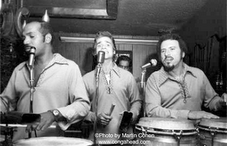
Julio Andino, 1914–1983: A Latin Music Visionary

In the winter of 1938, shortly after Machito arrived from Cuba, I met the bassist Julio Andino at the Park Plaza ballroom on 110th Street in Harlem. He stood out physically with broad shoulders, like a young Abe Lincoln, gentle-spoken in good English and carefully dressed considering that he was a poor mulatto. It was during the Great Depression and while the rest of New York was emerging, Harlem was still deep in despair. The Park Plaza was a refuge from the sadness of the time, offering melodies and memories of the islands that the locals had left behind but not forgotten. He had not come to the Park Plaza to dance but to listen and learn from the Happy Boys, the house band, with Doroteo Santiago singing. Pagani, the leader, invited Julio to sit in, as Noro Morales used to do with the then young Tito Puente.

When I spoke to Julio we saw that we shared a similar ambition, namely, to bring Latin music from Harlem to Broadway. But to come down the three short miles from 110th Street to 52nd Street meant conquering more than distance. An invisible shield kept the two worlds apart. Julio idealized a cultural crossover employing the magic of music as the means. He had ventured downtown and could foresee working beyond the confines of the black community where employment might be found. In doing so, his overlooked contribution was to become the uniting and strengthening of cultural/musical interests in the Anglo/Latino world. Without Julio’s vision and ambition for self and society’s betterment, Latin music might still be restricted to niches, jibaros and campesinos rather than the universal music it has become.

Cuba became a true nation when the Spanish military bands of Santiago blended with the Afro-influenced rumbas of the sophisticated nineteenth century Havana, a crossover opposed by aristocratic gentry of the time. This resembled the union of the West and East coasts thanks to the railroad that made us a proper nation. Julio’s ambitious dream was to hitch his music to the American dream, joining two worlds like Columbus. He had inherited a disrespectful musical world, one in which the phenomenal “Peanut Vendor” was to be a fluke, a melodic freak. He championed a lost cause, all the while knowing that buried treasure existed in the souls of all nations, waiting to manifest itself. “La rumba no hay frontera.” His dream was not primarily to lead an orchestra like Cachao and Oscar D’León, bass players, but to bring cultures in synchronization, not to join the country club of the pantheon of Puerto Rican all-stars for self-glorification, but to benefit all people; like an outcast prophet, he labored unrewarded, insufficiently acknowledged, where even Nicola Tesla and the scientist Fleming eventually received their high honors. He died leading his orchestra when actually it was the whole world he wanted to see, bounded in harmony, as Tito Puente has since done.

At the Park Plaza, the dance floor resembled a rush hour A train, except that the dancers were not stepping on toes. They were the very best dancers in that winter of 1938–39. Rene and Estela had just ended the routine that they had performed in Hollywood’s Thin Man movie, this time for the enjoyment of Lo Nuestro.

The dancers Electrico, Midnight and Chino (even a mulata was dancing on crutches) were competing during continuous applause—nonstop encouragement. The sweet scent of the tobacco of the tropics came up from the basement lounges, blending with the cologne in vogue, called Tabu. Most of the dancers were from the area around 116th Street (the main street before 125th Street became known as such) and from 114th Street, the most dangerous street in Harlem, perhaps in the whole city. They were frenetic but with wholesome Latin exuberance under the spell of a band that brought them “home,” to the islands of their enchantment, unlike the latter day sick Studio 54 that set dancers adrift, lost somewhere “far out” in space. The young girls, so shapely in their homemade, well-fitted dresses; the sharp guys with their black and white shoes, the mark of an accomplished rumbero. Slickened hair managed to overcome the huge overhead fans that were intended to cool off overheated dancers. In a musical orgy, like a feeding frenzy in a steam bath, they possessed the stamina of prizefighters. When the seemingly inexhaustible band gave signs of taking a break, the dancers were seen to prostrate themselves, pounding their fists in mock protest! Using silence as a clever device, the beat continued pounding there, like claves. All this punishing trickery would be skillfully and mercifully ended by the piano ever so casually, softly resuming the melody followed by the full band, released like wild horses. (During four days of Carnival in Rio, samba is nonstop.) Some dancers fell to their knees, pleading and supplicating the exhausted band. The entire company, dancers and musicians, ended in a joyful victory that defeated the gloom of the world outside.

There was no set closing time. It ended when the last couple went for their coats. Once outside, they crossed the street into Central Park to play out their deep arousals. The rowboats lining the lake soon served to cradle the partners under a cold grey sky. Here, far from palm trees, they shared mankind’s most heavenly encore. For the few who walked home alone, they could still hear Doroteo singing “Tu no comprendes” like a surrogate lover. Quite soon, they were in the arms of Morfeo. Tomorrow, Sunday, there would be another dance, bigger and better.

This then was the scene at the Park Plaza, where Doroteo’s untrained voice would sprinkle lyrical kisses over the heads of the dancers who sang along with him. Like an angelical conspiracy, it evoked a sweet tenderness that replaced the hopelessness of 1938 Harlem. Julio spoke with me during breaks. I couldn’t speak the language and couldn’t dance or play an instrument; still he viewed me as a way to help him defeat the dark pit of Harlem. Was he mad like most visionaries? To attempt to bring this Latin phenomenon to the lights of Broadway—into the big time in the Big Town!

“Forming the orchestra would be simple,” he said. There was an overabundance of unemployed talent. Placing a non-union band in “off limits” territory only needed some show-biz luck and a San Lazaro—or St. Jude.

First we needed a group photo to show us as already existing, at least on paper. Julio picked up a pianist (perhaps it was Ruben Berrios), two brothers playing great guitarras, and a young kid named José Mangual. I was to be the clavero, campanero, maraquero and manager.

Placing the “band” became the problem. I brazenly called the Major Bowes Original Amateur Hour located in today’s Ed Sullivan Theater, where several music publishing businesses had offices, including Sunshine Music Publishing Company that printed sheet music in Spanish and English.

A date for an audition was set. Minus our bongocero, José Mangual, most unfortunately, and inadequately rehearsed, this band with no name that resembled some hungry subway musicians, set up in the radio studio. With two songs only heard in Harlem, featured in the Cancionero Picot (a songbook distributed to bodega customers free of charge), we began. Toward the end of “Letrago,” we went into the montuno. The two judges mistook this totally unfamiliar change of tempo to be some sort of sloppy befuddlement on the part of the band. When we encored with “Tabu,” we realized we'd failed, but at least we had “played on Broadway”!

We left the studio defeated, but upbeat. The bright lights of Broadway in ’38 hardly reached up from 42nd Street to where we were on 53rd. Julio suggested a drink, not in celebration but rather to cheer things up. He mentioned the Half Moon on 81st off Broadway. Walking over a mile in thin clothing was impossible with the instruments. We entered the five-cent subway at 50th Street, where on a bench we found a pocketbook with fourteen dollars! Dividing this small fortune, we began to understand the whimsicality and capriciousness of show biz.

...to be continued