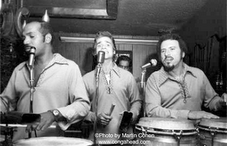
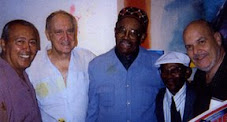
Showing posts with label Candido Cabrera. Show all posts

El Muerto Se Fué de Rumba

At East Harlem's Julia de Burgos Cultural Center, I attended Carmen and Rafi’s wedding recently. La musica got me up to dance with two girls as I had seen rumberos do at the Park Plaza and in many dance halls. To see two women dancing for lack of partners was like seeing a woman in a restaurant eating alone. Since I never met una puertoriqueña who didn’t know how to dance, I was not hesitant to twirl the two gals around in a fine salsa. What was to be a short dance turned out to be a performance by an 87-year-old bailarín with two gals, whose combined ages didn’t equal mine.

The same thing happened at St. Paul’s Apostle Church during the annual affair sponsored by the IPRPM. Aurora Flores with Dario at the piano and Papote gave me a big welcome, and I had to do something to deserve their recognition. Two elderly ladies were, in this case, dancing off by themselves and not together. I took the nearest one first, then the second one, and the three of us did the plena. One thing about this music—unless you’re drunk or a clown, age doesn’t stop Latino parejas or personas mayores from doing well on the dance floor. You rarely see that in an Anglo-crowded disco, sorry to say.

What is this “dancer” doing in a list of thirty-five musicians that included Dave Valentin, Cachao and Rene Lopez, all legendarios? Especially since all he could manage to play were maracas and the campana? It was at the Smithsonian Institute’s Museum of American History that I was honored to lecture to a small audience on my donation of posters, and then a bit about the very early days of la musica: the Cabarojeño Club in the Bronx in 1937, the Teatro Cervantes, the ’39 Cuban Village at the World’s Fair, the Café Latino in Greenwich Village in 1937 with Jose Mangual Sr., the Miami Beach dance studio and La Conga craze across the nation in 1940, the La Playa dancers at the Wonder Bar in Detroit in 1938, Tony and Lucille Colon’s studio at Grossinger’s, and talk about Anselmo Sacassas, Julio Andino, Electrico, Rene and Estela, the Havana Madrid. Everything I mentioned there involved bands, conjuntos, grupos or espantaneos. Musicians.

When we paint the picture of los veteranos de la musica Latina, los bohemios, little note is given to the rumberos like Raul and Eva Reyes, who performed, taught and carried the flag around the country. I can add that they fought for it as well, since it was threatened by forces like Arthur Murray’s and Fred Astaire’s studios. Those operations may have helped a bit to bring la danza before the public, but it just wasn’t the real thing, lo nuestro.

What’s a six-foot Italian-American Brooklynite who didn’t speak la idioma doing playing “Bruca Manigua” on a harmonica for the audience at the Teatro Cervantes in 1937? What is he doing in the company of the greatest musicos, allowed into their dressing rooms, back stage and in their homes, invited to bautizos, weddings, birthdays like Louis Mangual’s 54th in Yonkers?

Never was I made to feel unwelcome, out of place or intruding. On the contrary, the abrazo fuerte bien puertoriqueño was the greeting, like two hermanos de leche. It’s more than hospitality, good manners and friendship—it is the affection, the gran afecto, that one feels like a mano, like the looseness I felt while singing a duet (“Tu no comprendes,” a song our long-gone friend Doroteo Santiago recorded in ’38) with Leo Fleming Jr. in my kitchen. How come he could greet you with “Ecobio monina boncó,” an amigo de pecho, could do a tornillo and ate chicharones de Bayamon?

How come he knew the lyrics to “Ofelia tenia un platito,” “Niebla del riachuelo,” “Vereda tropical,” “Pare cochero,” “Negro de sociedad,” “Un poquito de tu amor,” “Fufuñando,” “Santa Barbara bendita,” “La ultima noche” and “Timba timbero”? How did he find himself dancing along with Los Dandy’s de Belén? He was even digging Candido at El Kursal in La Vieja Habana in 1940, and in Maestro Lecuona’s dressing room at the Teatro Payret, opposite Sloppy Joe’s. He danced to Trio Caney on the patio of the Beachcomber, hung out with Louie Varona and “Jack, Jack, Jack” Bolivar at the El San Juan Hotel. He stayed at the Normandi Hotel, swam in El Convento’s small pool and had a shoeshine at the corner of Calle Luna.

Uneraseable reflections…stories behind the music that will be with him, not in la blanda cama, but while dancing with his nurse to “Chacumbele, el muerto se fué de rumba.”

Some Stories Behind the Music

Most Anglos' knowledge of la musica Latina begins with Desi Arnaz and ends with Tito Puente, with little in between. Yes, perhaps Perez Prado, called the Father of Mambo, but how about Papote, Papaito, Perico, Paquito, Patato or Pupi? Anglos know B. B. King and “Jelly Roll Blues,” but how many of them know Miguelito Valdez, or that Cab Calloway imitated Miguelito’s authentic Nañigo ritualistic chanting, turning it into a gibberish called “Heidi, Heidi Ho” that made a mockery of an authentic Afro incantation? It made Calloway a millionaire, with no thanks or acknowledgement to Valdez.


One can learn to dance salsa easily enough, but where does one acquire the ability to discuss the merits of Manny Oquendo y Libre versus Larry Harlow, as Nashville does with their numerous Country Western stars, or talk about Marc Anthony and José José or the greatness of Celia Cruz?

To fully feel the music, one must know the players. Imagine enjoying your rock and roll and never knowing anything about Elvis. That is the sorry state of the Latin music scene as it concerns the Anglo adherents. Information gained concerning the music you are listening to or dancing to makes one a skilled player in the conversation setting as well as on the dance floor. Max Salazar’s Mambo Kingdom is an excellent source book along with The Latin Tinge, but more of the same is needed, especially in the popular press, on the Internet or in the living room.

The following encounters with the music and the individuals involved as experienced by an outsider, an Anglo like yourself, can bring this remarkable music into your life and give you el alma creola.

Anglos might know the “Watermelon Man,” Ramon “Mongo” Santamaria, but how many have heard of Candido (Julian Cabrera), who at age 87 is still beating conga around the world?

I first heard Candido at the Kursal club in Old Havana. It was sixty years ago while I attended the University of Havana and steered tourists around the many hot spots for pocket money. We took them to the Teatro Shanghai to see the stage show that openly featured the big star (porno), Superman, a household name.

We had mojitos at La Zaragozana for lunch, rum añejo before dinner at Sloppy Joe’s, Scotch and sexy super-spectaculars at La Tropicana and a late morning dip in the pool at the Hotel Nacional. When the Tropicana show began, gamblers returned to their tables, a problem for the house, that has since been remedied in Las Vegas by separating both activities into “rooms” that share charge admissions

Spanish names like Rodriguez make for a blended, extended “family” made more confusing by the tendency to add somewhat of a clarification in the form of “pet names.” For example, Candido Cabrera is not to be confused with Candido, the timbale player named José Rodriguez, or bongoceros using “bongo” as a middle appellation such as Bobby Romero and Harry (Bongo) Rodriguez. The greatest in my opinion and in that of many others was the extraordinary bongocero José Mangual Sr., who adopted Buyú as his stage name.


I first met Buyú in 1937 at the Café Latino on Grove Street in the Village, and was at his bedside toward the end at Mother Cabrini Hospital seventy years later. Until that meeting, the only “Spanish Music” I knew was “La Cucaracha” and “Alla en el Rancho Grande.” When Buyú beat on what some people called bongos (“tom toms”) and maracas (“rattlers”), I went searching for the real thing. I traveled from Fort Hamilton across Manhattan and up into the Bronx to the Cabarojeño Workers Circle to hear it. Closer to home was the Park Palace on 110th and Fifth Avenue. It was there that I met Julio Andino in 1937.