Among the ten top artistic directors and orchestral conductors is Daniel Barenboim, earning two million dollars a year, or should we say a season. In fact, these ten lucky individuals take in over ten million dollars in salaries! Not bad for a clique of sophisticated elitists in the symphonic and operatic establishments. Fundraising gala performances could use some housecleaning. Charity begins at home and should end in the street, where it will do the most good. To the people!
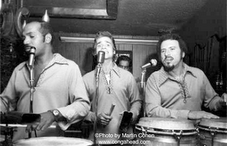
Are the complexities of Mahler’s Ninth Symphony any more challenging than a salsa montuno performed by Rene Lopez’s twelve-piece orchestra, where a close listener can catch experimental, classical, serial, modern and postmodern influences?
Music should serve to spread the maximum good the greatest audience. It should best be out of Lincoln Center’s grasp and out in the street for the people, by the people and of the people…a birthright. For every black tie fan attending the annual Mostly Mozart festival, a thousand Latinos are enjoying Marc Anthony’s latest hit.
A worldwide survey found Puerto Rico to be No. 1, the happiest place on earth. Is it because many poor families harbor at least one musician or more? More than an evening’s gala is present night and day in the Latin music that is in the air one breathes…out in the streets of P.R. It is not in the snooty confines of academic strongholds that are constantly begging for donations to stay alive while attendance dwindles. Is this not a good example of snobbism, where unknown names perform unknown opuses to a restricted, mostly tax-sheltered “select” audience?
When the average music teacher struggles to secure pupils that struggle to afford lessons themselves, this in itself restricts not only the appreciation of music but also its influence. Money should not only go into offering scholarships but also into making musical instruments available like library books to students who cannot afford to buy them, like giving them chances to learn how to fish, instead of giving a handout.
In an alley alongside a nightclub opposite El Capitolo in Havana once stood an old beat-up piano. It was placed there during the day and rolled out front at night where the Anacaona all-girl orchestra played on the sidewalk as people passed by. We could call it, today, a free concert. During the afternoon, anyone who wished to play that piano (while standing) could do so. Strangers would crowd around it and sing along as though they were fraternity boys joining in. They would continue singing as they left to continue their day. This is what music is really all about. It is our global anthem.
Even before the Great Depression of the 1930s, many hungry children in New York without supervision would eat their crayons, swallow white paste, chew tar like gum, and ingest lead paint for salt. It was this lead, not decibels, that damaged my hearing. However, this unfortunate handicap served to introduce me to the exquisite sounds of Latin music.
The vibrating chords of a solo organ playing “Siboney” awoke a withdrawn child. The penetrating sounds of this grand orchestral device came from thousands of miles away, from the Hotel Nacional in Havana. “Siboney,” the theme song of the Lecuona Cuban Boys, came in via shortwave radio, full of static, fading in and out, at times completely silent, clearer in summer than winter and very late at night. “Turn off that radio!” my dad would shout from the other room. Turning down the volume a wee bit, I would bring the radio under the sheets with me, married as it were, to the music. Next day, I would fall asleep in class.
Between my family’s understandable protests, the poor reception in the early days of radio, and my troubled hearing, I could only remain frustrated by this foreign music. These novel sounds were unknown in this country during the 1930s, except for one magical tune that was heard around the world: “El Manisero.” I became determined to someday track down this elusive, enticing music to its source.
Today, some seventy years later, I still bring my radio up to my ear by using earphones, and while my hearing has worsened, the technology has improved. In 1941, the composer of “Siboney” invited me into his dressing room. He sat down at a small piano and, looking directly into my eyes, began to play “Estas Siempre en Mi Corazon.” “You are the first one to hear this song,” he said. This is where the music has been all these years, I thought…always in my heart
From an Interview with Vincent Livelli by Judy Samuels
Vincent Livelli first “awoke from infancy” at 117 Sullivan Street in Greenwich Village.It was when his mother took him to the window to see his first snow. She picked up a handful of snow from the window sill and put it in his hand. She taught him about fire the same way, but much more gingerly.
In the 1920s, European immigration was at its peak.The Village social parlor was the streets, which were arenas of volatile class tensions as well as communal mixing. The South Villagers, though mostly all Italian, were deeply divided by region and class — the Genoese looked down on the Sicilians; the Sicilians resented Genoese business success and adaptability (They called them the Jews of Italy).Vincent’s Genoese family owned the building they lived in, and their landlordly position stung the Sicilian tenants’ sense of pride.
Walking to school at P.S. 102 on Varick Street, Vincent would be bullied by kids on the street and sometimes spat on from a tenant’s window.He escaped this fate when he walked to Central Park with his older cousin Jimmy.Jimmy worked in the paper box industry in the manufacturing district now called Soho.Sometimes he carried his younger cousin on his shoulders.In Central Park, they would go skating on the frozen lake.
Vincent remembers, as do some of us, when the Jefferson Market Library, back then the Jefferson Market Courthouse, was of a piece with the Women’s House of Detention.The inmates would yell down through the barred windows to the street and throw messages to friends on Sixth Avenue.Around 1974, the Women’s House of “D” was torn down.Today its memory is blanketed under lush flowering plants in a lovingly-tended neighborhood garden.
Vincent was born in Brooklyn and at six months old moved to 117 Sullivan Street, which he shared with his mother, father, grandparents, Aunt Tessie and unmarried Uncle John.Just across the street was the stable where the teamsters’ horses were bedded down.Their carts were parked in the street right outside his window.Before there was window screening, flies from the horses would invade his room.He could look out his window on hot summer days and see the horses returning home tired from pulling the beer wagons through the city streets.He watched as they climbed slowly up the incline to their stalls, and as the impatient teamsters beat them to hurry them up.The misery of the overworked horses came through the window with the breeze that carried the smells of hay and horse urine. At three years old, Vincent saw policemen shoot horses that were foaming at the mouth from exhaustion.He saw them drag the bodies through the streets.
When excavation work began on the Sixth Avenue Subway, Vincent played in the mountains of sand that piled up.He lit the gas lamps in the hallways of 117, held aloft on his grandfather’s shoulders.The building had two communal toilets on each floor — the pull-chain kind — that served three families.The coolest places in the building, in summer they were a popular escape from the stifling apartments.
In the twenties, poisoning from lead paint didn’t recognize class differences.Many children suffered the effects of eating the flaked-off paint chips from apartment walls.
Vincent, despite being affected with permanent severe hearing loss, learned four languages, andlearned to dance and love Latin music from his Sicilian mother.For his first lesson, she climbed up on the kitchen table and danced. She told him stories about the Black Cat, the cabaret on West Third Street, and Mori’s Restaurant on West Fourth, popular in the 40s, that had a fountain in its inner courtyard.But the San Remo Bar Vincent discovered on his own.
Located on the corner of Bleecker and MacDougal Streets in the heart of Italian Greenwich Village, it became home to the“Village nobility” of the1940s and ‘50s.Anatole Broyard, who Vincent met at Brooklyn College, was at the center of a literary circle that included French diarist Anaïs Nin, poet Delmore Schwartz, writers Milton Klonsky and William Gaddis, and other artists and writers.
At Brooklyn College, Vincent was an outsider among the mostly Jewish, staunchly Leftist crowd.Anatole Broyard, the son of a New Orleans carpenter and a light-skinned black man, was equally set apart.They became close friends for the rest of their lives.Though neither of his parents had finished elementary school, their son became a writer and a book critic for the New York Times.In 1938, the two got an apartment together on West Third Street where the rent was ten dollars a month.In 1945, they opened a bookstore at 18 Cornelia Street, which became a literary nucleus in the Village, a favorite hangout for Maya Deren, the high priestess of experimental cinema, and writer Terry Southern, among others.Anatole’s Greenwich Village memoir, Kafka was the Rage, ignited an interest in European literature.
In 1948, after serving in the army in World War II, a cold day job-seeking on Wall Street made Vincent dive into a steamship office to warm up.Destiny must have had a hand because the world suddenly opened up with that steamship office, and, instead of Wall Street, he picked up a job as cruise director on a ship to the Caribbean, a career which would take him to sixty-five countries.Back in New York City, in the midst of the Depression he learned Latin dance at the Park Plaza on 110th Street off Fifth Avenue, where poor Puerto Rican and Cuban families went to reclaim their lost cultures.
In a letter to Anatole’s daughter, Bliss, Vincent told her how her father had “refereed a certain decorum” when engaged in heated literary discussions with others at the San Remo Bar.“Nimble with words, his sentences skipped along, churning the air with words never heard before. . . . “Tempers raged in this bar atmosphere as people argued their literary opinions.“There were days when they would cross the street to avoid each other because of Proust.”
Late in the 1940s and into the ‘50s, the elegant iron grillwork began to disappear from many Village balconies.NYU began its expansion, and with it the historic streets of the Village were rearranged or broken up.For Vincent this was the time “Anaïs Nin opened her diaries [to the world], Sartre’s ‘Huit-Clos’ opened on Broadway, and the Mob controlled Saints’ Days.”The intimate romance of the Village was disappearing.
The building at 117 Sullivan Street is today a condominium.An apartment in this buildingwith no super rents for $1,300 a month.Vincent Livelli spent the decades of the sixties and seventies traveling the world on cruise ships, a Latin-music missionary.“Is it not better,” he wrote to Bliss, “to follow the way of the self-forgiving solitary traveler?”
Vincent and Anatole were sharers in the post-World War II Village where friendship and love were bound together by love of poetry and literature.“Everyone was writing.” One afternoon, Vincent met James Baldwin coming out of the bar at the Carlton in Cannes, France.“He gave me his number, and when I called, he said he would do a portrait of me, in the style of Matisse or Van Gogh.He once sang for me to keep the cold at bay in his wind-swept loft.”
In 1954, Anatole’s first published story, “What the Cystoscope Said,” gained him status in the world beyond the Village, but strangely prefigured his death from cancer years later in 1990.From his experience as a patient, he wrote the collection of stories Intoxicated by My Illness; it was Anatole’s posthumous gift to the world.In it, he gave a literary voice to illness, suffering, sex, and death. "I’m not interested in the irony of my position,” he wrote. “Cancer cures you of irony. Perhaps my irony was in my prostate.”
Vincent, who “walks the Village with his friend’s ghost, knows this is where his heart still resides, among the landscapes of our happy youth.Thus, we are joined together not in sadness but in the feeling that we were so close to a miracle that we could have saved the world.”
Vincent Livelli, far right, in 1948 at the Embassy Club, Plaza San Martin, Buenos Aires
Unless one arrives in a foreign country with letters of introduction, it is necessary to form new friendships and new experiences on your own.
In 1948, I showed up in Buenos Aires with plenty of friends whom I had met aboard the SS Argentina. Furthermore, these new friends were all high society. For example, Luiz Herrera, the world polo champion and race-car driver, who was the Maradona of his day, when polo was what soccer is today in Argentina. Also Samuel Jankelovitch, Evita’s impresario, and the Urquiza family, like our Kennedy clan. These folks met me at the dock in their Cadillacs when I would return to Buenos Aires, at a time when importing foreign cars was illegal. It was also a time when, since the British had built the nation’s railroads, the sight of British tweed jackets, cravats and English Leather cologne was in evidence everywhere. Within this circle of companions, in a hospitable country, I felt comfortably ensconced…that is, until I recently read the bookTango: The Art History of Love, by Robert Farris Thompson.
Where I had always received a warm Buenos Aires welcome, had I arrived cold, my present memories of those days would be quite different.
I was hanging out with the wrong crowd, listening to white (chongo) tangos of Carlos Gardel and frequenting clubs with the aristocratic atmosphere of the 1940s tango del salon. Forever in the upper-crust company of politicos and shifty club owners, I stayed at fancy hotels such as the Plaza, across from the Embassy Club on Plaza San Martin, owned by a Señor Kootcher. His elegant club was where we danced and dined, dressed tenue de soiree, on my nightclub tour of Buenos Aires that included a stop at the La Querencia club for some gaucho entertainment (malambo zapateado) and ending at the Gong for Americanized Argentine jazz. After the tour, I would finish off the evening at Cabaret Tabaris. This club was balconied and had a telephone at each table, which allowed you to connect with attractive unescorted ladies—and idea borrowed from European clubs.
Until I read Prof. Thompson’s Tango, I was unaware that there was another Argentina, where tango is to its citizens what rumba is to Cubans. During the time I lived in Havana, Cuban society was already beginning to more openly accept Afro-Cuban talent, whereas Argentina during that era of more British-influenced mores, was hiding the African origins of its national dance—its beating heart.
True, there were districts in Buenos Aires that were equivalent to the solares, patios and bateys of Havana, but I never knew of them. Never did I see Afro-influenced canyengue tango, where the male partner’s knees are bent with his torso pushed forward (this style is similar to Killer Joe’s hot rumba as he showed it to us at the Palladium). Nor did I enjoy black malambo, a dance of ritual purification that, like teeza maza, features explicit foot stomping as part of the tango. I never knew the ki-kongo power that drives the tango. I would not have feared entering the La Boca district, the city’s inner port with its bars and brothels, where tango was born.
Like being in love, faithful to one woman all my life, I only knew Afro-Cuban cultures, until I read that tango was born of the same mother: Mother Africa. Now my vocabulary includes yumba (“God’s command”), mufa (“bad luck”), mayembo (“trembling shoulders”) and other words added to my Afro-Cuban abrecuto quri dinga and babarabatibi coibi, etc.
Where I easily found Africa in Belize, not to mention Haiti or Boriqua, I feel I was cheated of memories that would today take me, like those I have of Cuba, to darkest Africa—the darker and hotter, the better.
Havana in 1941 was one of the gayest cities on earth. With pristine beaches, lively music, tobacco, rum and beautiful women in abundance, it was a tropical paradise in the sun. Who could choose a better location to wait out the war in Europe?
In the upper-class sector of Havana, Vedado, about thirty families were living, not as Cuban refugees, but Jewish refugees. They had managed to escape the Nazi persecution but they lived from day to day in despair, with no means of support other than donations from Jewish charities. Many had endangered relatives in Europe. With little chance of returning to the ruins of their former homes, they survived as best they could. Not permitted to hold jobs in Cuba, they were desperate people.
Among the professionals, artists and businessmen, were many tailors whose wives took needle and thread in hand and made neckties for sale. During the Great Depression, this strategy had earned poverty stricken Jewish families money for food. The gift of a necktie for father at Christmastime arose then, during the birthdays and holidays, as a result of this activity.
Since Christmastime encouraged the greater display of decoration, these Christmas ties enlivened the male wardrobe, adding cheer to a sad time in America, and helped to break the somber style of dress in general in America.
In Cuba, however, the tropical climate and the absence of air-conditioning meant a need for loose clothing. An example is found in the typical Cubavera, a shirt with an unbuttoned neckline and no tuck-in at the waist. Even today, neckties are being abandoned in greater numbers around the world.*
When the Jewish refugees saw me passing by daily, they became more and more curious, and more suspicious of me. Could I also be a refugee, they wondered? I was approached by the salesman one afternoon, who had at last spotted a likely customer. Here was a gentleman who actually was wearing a tie in Havana!
It was an easy sale. I bought a tie since I could not only use one, but because the price was cheap. Besides, it was practical souvenir of Cuba to take with me when I returned home, to remind me of those who had lost theirs.
1939: Winter audition for Major Bowles Original Radio Amateur Hour, at Ed Sullivan Theater. Buyú, Julio Andino and Ruben Berrios, piano, two brothers on guitars. I managed the band (with rhumba shirt); clavero. No luck. Tried at Chin Lee’s Restaurant, near the Latin Quarter Night Club. No luck. No money.
1939: Went with Julio to meet Machito at the Half Moon (one flight up, Broadway and West 81st Street), after aforementioned audition for Major Bowles. Passed out from rum. Julio put me in the subway, Fort Hamilton local to the last stop.
1939: Met Katherine Dunham dancers and Jack Cole dancers and hung out at the Cuban Village amusement area, New York World’s Fair. As an understudy, I learned el diabolito and la mula and el sacraficio, Nanigo dances. I was fired for shooting dice in the dressing room.
1939: At the Café Latino, Greenwich Village, shot crap with Buyú in the cellar (now called One If By Land, Two If By Sea, an expensive restaurant).
1939: Met Nino “the Great” Yacovino. Joined his troupe, three couples. Worked at the Rhumba Casino at West-End, Long Branch, New Jersey. Did solo with my partner, Gloria Cook (“Cookie” was Al Jolson’s mistress). Have photos and clippings. Joined La Playa Dance Troupe and worked the Wonder Bar on Woodward Avenue in Detroit (great show town!). Met Raoul and Eva Reyes there. Cugat at the Statler Hotel in Detroit, on tour. Frank Sinatra was at Ross Fenton Farms in New Jersey.
1939: Stayed at the Kingsley Arms Hotel, Asbury Park, NJ, where I had my studio in the solarium and taught Rhumba.
1940–41: Received wire to go to Miami Beach to join Cuban Troupe, three couples, plus Pepito and Carmen at the Carrousel Club cum revolving bar, featuring the craze: La Conga! Taught dancers around Miami Beach hotels, in my own studios: Bali Club, Hotel National off Lincoln Road, and at the Tatem Surf Club (exclusive Christian “No Jews” policy). Also at Coral Gables Country Club (restricted). Orchestra Ina Ray Hutton, all-girl orquesta. Attended University of Miami; exchange scholarship to University of Havana.
Your interest in Greenwich Village shows me that you are an artist at heart. With me, it was an accident of birth that placed me here, fortunately. I say fortunately because this is where I feel I most belong. If I could have had a choice, it would have been here or Paris, so much so that when I meet a Parisian, I feel I have much in common with him.
This is where I awoke from infancy when my mother took me to the window to show me snow in the backyard. My first view of “the world” was a beautiful one. Because the Ninth Ward (as Greenwich Village was once called, in the early 20th century) was so overrun with violence from street gangs, it was unsafe for me to play in the street. Furthermore, since we were landlords, there was much envy and hostility toward my family. I was only allowed out in the company of my grandmother or my uncle, on their daily visit to St. Anthony’s Church (Shrine), that my grandfather was instrumental in establishing on Thompson Street. He hoped to help the community and at the same time increase property values in the neighborhood. Today, his dream is realized, I’m happy to say.
He admired and spoke often of the Germans, a more settled element in the city. “A walk in G.V.” referred to row houses north of Washington Square Park. These stately mansions were called, in my grandfather’s time and even today, the Rhinelander Estates (now owned by NYU). He had traveled all over Germany as his old passport shows, and was in the piano-string business at 5 Bedford Street, with a German family. He may very well have built the hurdy-gurdy organ that he’d carried around Europe as a musiker. He owned a stable and opened a bar to sell German beer. In those days, the Genoese families in the Village drank beer more than wine, since it was more readily available. When I was 9 or 10, I would go for beer for the men working on West Broadway (now Soho), bailing rags and paper. They called such young children “go-fors” in English, even though the men working the huge compacting machines were all Italian-Americans.
My father was a journalist, having been born in New York and having graduated high school. He began his newspaper career as Arthur Brisbane’s office boy and worked his way up to investigative reporter with the New York World and the New York American, both Hearst newspapers. He may also have worked at the old New York Evening Post (the editor was a certain Mr. Swope).
The Village at this time was very crowded with poor immigrant families. Walking to PS 102, on Varick Street, I would be bullied, and sometimes spit on from tenants up at windows who identified me with my landlord family. Soon I was not allowed the natural pursuits of young kids and was kept tied to the fire escape. A cousin older than I would walk me up to Central Park and back, especially in the winter to ice skate on the lake. He would have to carry me home on his shoulders since it was quite far for me to walk. He would skate with me on his shoulders as well. His mother, my aunt Tessie, and my unmarried Uncle John, my grandparents, and my mom and dad were all obliged to live in the building. For safety, my dad moved me and Mom back to Brooklyn when I was 10 or 11. I had originally been born in Brooklyn, at a time when all the apartments in my grandfather’s building at 117 Sullivan Street were taken. As soon as a vacancy occurred, when I was 6 months old, my dad had us moved into my grandfather’s building, so I consider myself a Villager.
I remember what is now the Jefferson Market Courthouse Library, when it had a women’s prison attached to its property. That part was torn down around 1960, especially since the ladies would be yelling down from the barred windows at friends and passersby in the street and along Sixth Avenue. I played, jumping in the mountains of sand being excavated while they were building the Sixth Avenue subway, coming home all sandy. My real playground was Washington Square Park, where I was taken daily after visiting Pompeii Church and St. Anthony’s, to ride my tricycle…the envy of the neighborhood kids whose families could not buy them one. We sat by Garibaldi’s statue, since my father was a “Garibalino,” instrumental in raising money for the statue. He came to America in 1861 to join Garibaldi, who was living on Staten Island at that time, prior to leaving to fight in Peru against the Spaniards. He bought acres of empty land in Rego Park and Forest Hills but sold it in order to finance his son, Dominick (my uncle), who was running for mayor of Hoboken, where there was a very large community of Sicilians (who were being oppressed by the Irish political machine and made to work for a dollar a day paving streets). My uncle lost the election, and we became much poorer over time.
Today the rent for an apartment in what was my grandfather’s building on Sullivan Street is averaging $2,000 a month. Next to this building, I remember outhouses before there was central plumbing. The people called them “back houses,” as the historian Barry Lewis mentions. In Italian, “bacahows” or “cessos” (the second word comes from “cesspool” in English). Today you enter a tight alley to go into the backyard of the two buildings, where now there is a small cottage. This occurred in many instances where the space was used to build cottages where formerly there were crude toilets. Even as late as the 1960s there was a public toilet (men and women) around 17 Perry Street. Most of the kids were poisoned eating lead paint chips, as they still are today in poor neighborhoods in the Bronx and elsewhere in the city.
My mother loved dancing, and spoke of the cabaret named the Black Cat (I think it was on West Third Street, in the 1920s). Mori’s was the popular restaurant on West Fourth Street in 1945, which had a fountain in the interior yard. MacDougal Street was lined until just after the Second World War with private mansions with iron balconies and railings. The Provincetown Playhouse was there in 1946 through 1948, as was a nice club called Salle de Champagne, where guests sat on cushioned seats and drank champagne. A jazz spot named George’s was at the northeast corner, at 69 Bleeker Street and Seventh Avenue, and then, after the war, there was Louie’s on West Fourth and Barrow (today the One if by Land restaurant is located down the street).
In the hot summers when I was a child in the Village, horses would die in the streets, cops would shoot them, flies entered windows before screening, and recalling stable smells keeps me from liking horses to this day. I lit the gas lamps in the hallways of my grandpa’s building, while carried on my dad’s shoulders. The two communal toilets on each floor served three families and were the coolest places to escape the hot apartments. My dad bought me clothes on Orchard Street and, at 8 years old, I was always wearing a hat, which I took off to greet people as I bowed to them. My best friend was the son of the Jewish candy-store owner on Prince Street, when I was 9. My childhood in the Village was proper and not difficult compared to other kids, many of whom went to jail. Today, my Village is an abode of memories that will inhabit me forever.
Born in 1920 in Brooklyn, New York, Vincent Livelli has been a lifelong Latin music enthusiast. In his quest to bring salsa to the masses, Vince has made his archives available to the public. They reflect on the power of the music as well as Vince's first-hand accounts from Cuba, aboard dozens of cruise ships, and in ports around the world.