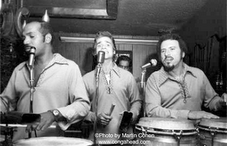
While dancing with a partner, Electrico was one of many, but as couples left the floor, including his partner, he went into a solo as the band continued playing, now for him alone. We soon saw that we were in the presence of greatness. Here was something stunning, like Mike Tyson's debut in the boxing world. He would arrive and leave alone. No one embraced or approached him, respecting his stature with distance, as we did on the dancefloor proper. A low key modesty characterized his social behavior. Only the musicians, the drummers in particular, were seen close to him. Respect was more appropriate than celebrity. In 1938, dancers dressed in a serious fashion, with jackets and tires and gray suites (except for Midnight's black suit and vest). The scene at the Park Plaza was incongruous with raw African moves dressed in Western garb. His partner was the seated drummer more than una Latina. They were working rather than performing, as we tried to catch their smallest gestures.
There were many Electricos in Cuba, but here in New York, we were unaware of them. After his style became a name called Electrico, others became known as dinamita, mecanico, el indio, Killer Joe, Cuban Pete. He seemed embarassed for having made us all look like unaccomplished beginners. It took years -- almost ten -- before the stars at the Palladium caught up to his style, but I never heard his name mentioned. In fact, on one ever knew his name. That is true celebrity, like the Unknown Soldier.
What would Arsenio, Cachao or Lecuona Think of today's Latin jazz? Would they be welcoming the growing global phenomena of la musica while at the same time supportive of the jazz contribution that distributed it worldwide?Ever protective of Afro-Cubanidad, Arsenio cried, "Iese maldito mambo!"
According to Bohemia Magazine in 1952, Cachao was slow to embrace Latin jazz and I doubt Lecuona would have embraced it any faster. But times and tastes change us all. "I once was blind..." Gone is my Latin Jazz criticism. Discarded is my fear of any calamitous consequences supposedly involved in the merger of Latin and jazz. Perhaps I lacked the secret teaching, the "disciplina arcana" essential for such an unpopular undertaking’s success. All music is musica sacra.It is commercial materialistic greed that befouls all.
The drums have spoken and I have taken this proper moment that the ancient Romans called punctum temporis, to surrender to better sense. Las dos alas de Latin Jazz make better bedfellows than my malingering, my belittling the evident advantages of a union that benefits both houses like a royal marriage.
All this does not change my duty. I was assigned a mission back in Regla in 1941 to promote and protect Afro Cuban music around the world. One can become popular by becoming unpopular. But as Charles Baudelaire (paraphrased) said, "Latin ou jazz, qu' importe?"Good or bad, the ardent masses on our dance floors prove it. This music within itself dispels counter-productive differences that tend to exist among mankind naturally. Viva la musica!
Fancy footwork on the dance floor was a form of foreplay, complete with perspiration, panting, and pre-coital contortion. Friction caused internal combustion in such a pressure-cooker environment, often leading to consensual mutual masturbation called “dancing.”
Where else could such somatic satisfaction be bought for a $.35 admission price? A price that could include outright orgasm? Cover and excuse for ecstatic behavior was provided by rhythmic overtones. Expect dancers abandoned concentration on agile footwork in order to create, instead, intentional sexual excitement. They played the women like slide guitars -- finding her center of gravity located in the small of her back. By raising his supporting hand, or by lowering it up and down her spine, the couple achieved better focal contact. Raising his hand allowed him to brush her nipples as she rotated in front of him.
Lowering his hand down her spine brought the lower part of his partner’s body to him. This enabled her to press hard, rubbing against his leg like a pole dancer. This vise-like conjunction could skillfully remain in place even while dancing. Remaining in one corner meant better communication, concealment, and concentration. Unnecessary conversation, especially in the dim light, was like phone sex whispered in her ear. Her name, added to the lyrics, her head on his chest, induced romance. Sexual signals were ocular, sensed, mouthed, physical, or very obvious.
Loving intimacy, shared confidence added to gallantry, grace, speed, surprise and strength defined expert foreplay, as well as great dancing proper. A parting kiss, not on the cheek, but on the neck or hand, together with playful laughter at the end pardoned the risqué behavior of their shared secret.
Post-script: Calle Ocho, Miami, 1999: El Baile del Gato. Four couples down on all fours dancing doggy-style never caught on – in public at any rate.
As I write, the Septeto Nacional is playing “Echale salsita” and “El son es lo mas sublime para…,” right here in New York. Ignacio Piñeiro was a contemporary of the most popular bandleader of the 1930s, Paul Whiteman, was billed as the King of Jazz. Naturally, black musicians protested the white man’s gratuitous label (as B.B. King would become their king.) Whiteman, as we believe, also influenced Ignacio when he introduced the phrases “get hot” and “hot stuff.” The salsita connection is evident and was also popular with black jazz musicians. Latin composers contributed “Calientico,” a popular rumba at that time, and spiced-up tunes.
When African-rooted jazz musicians began to hear Miguelito Valdes’ Yoruba-authentic ritual incantations such as “Bruca manigua” and “Babalu,” and Arsenio Rodriguez’s “Sabroso y caliente” and wild “bembes lucumies,” and Chano Pozo (as, later, Celia Cruz would sing “El Quimbo”), they tried to adopt these odd-sounding chants. But ended up with “heidi, heidi, ho,” “cubop, bebop,” “rumba boogie,” and whatnot.
“La-di-o-de” is a sacred invocation. Latino musicians did not protest what could have been called an insult to their patrimony.
Music is aria made sonorous, and humans will produce it as part of our seventh sense: the sense of rhythm that resides in our brains. That sense is in the company of our other senses, including our sense of balance, located not in our feet, but in our ears.
It doesn’t matter who influences who, but to the struggling musicians of El Barrio, it mattered. Last year, Willie Colon, playing New Year’s Eve at Del Posto Restaurant in Manhattan’s meat-packing district, was able to advertise: $850 per person for admission! Sold out! Musicians can never be paid enough. Let’s remember, it was music that helped bring us out of the Great Depression, not the bankers. We sang “Happy days are here again” throughout the country, and the musicians were our pied pipers.
Speaking of mimicking, in the dance world, the Twist was an explosive effort, and sad excuse to deride, willfully or not, the hip movements of the rumba, humorously. Anglos had uptight social attitudes that were made acceptable under the cloak of comedy, like minstrels. The playful Twist became the forerunner of Elvis’ rock ‘n roll show, with roots in the South. (Webster’s dictionary claims that rock ‘n roll “derived from rhythm and blues,” but I say it was the Twist.) If the Twist had gone north, and on into mambo instead, imagine what our culture would have become! Elvis never learned salsa and if he had I’m sure our colleges would have less trouble teaching Spanish, for one thing.
I’ve heard many bad rock ‘n roll bands, but never a bad conjunto. Are the hundreds of pop groups trying to reach the heights of the salseros? African drums have saved many Latin jazz performances, but can we please get rid of those big, fake conga prop drums on Jay Leno’s show? Why don’t we have a term, Afro-jazz? Who can dance salsa wearing a Mexican sombrero, and how many of us can dance a Dancing With the Stars salsa?
Like the old Morse Code, sound waves send messages out into space. In this fanciful premise, we claim that claves, with their asymmetrical rhythm, have a disruptive influence on the atomic celestial clock. The classic tick-tock, one-two, one-two beat is disturbed by the clave’s one, pause, one-two beat.
There are no events without the involvement of energy. Some planets release energy, such as the sun, while others both emit and receive energy, such as the earth. The sound waves of the claves disrupt the symmetrical flow of orderly emission of energy. The repetitious clack of the claves would hypnotize a listener if it were not for the pause that is its distinguishing feature. With this pause, the claves control the entire orchestra. If we were to modify our clocks to mimic the claves, replacing the regimented sound of seconds to the clave beat, we would syncopate the music of the spheres.
We humans are not sufficiently inspired by such possibilities. The magician employs a pause to achieve his trickiness. In that significant instant, he accomplishes his purpose. Nature may “hate a vacuum,” but the vacuum (read: the pause) exists for good reason. The claves involve man in the way the cosmos works. They may command the respect and control of the celestial orchestra, like a Toscanini. What is repetitive in clave rhythm can be called cyclical when applied to the cosmos. If life is both the teacher and the test, claves can be said to cheat, by not fitting the mold. Our learning never seems to fit into our lives properly.
The workings of cycles influence education itself and can, with their foreshadowing, show us the unseen, the unknown, and in that way achieve the goal of education. We mortals invite the sickness of misfortune by waving our fists in the face of the gods with our prideful approach to learning. The answer is in the claves: two simple wooden sticks.
When one steps outside the circle of the family and by doing so, encounters the true world for the first time, whatever knowledge gained in that way has a tremendous impact on the future course of one’s life. Americans taking le grand tour of Europe returned home with a cultural concept with high values. Thus, we became a society interested in learning. Parents today who send students off in mass to Cancun, Jamaica, Nassau for instance, expose these young minds to other influences. The students quickly adopt as part of their formation unrefined behavior, mediocre interests and less sophisticated lifestyles.
Next to visiting a foreign country is the familiarization gained through the literature that country produces. Visiting the West Indies, literary achievement is scarce, and it is music that has the power to influence and formulate the direction of one’s life, perhaps more than parenting.
What has this to do with the Park Plaza? Like a first time encounter with a foreign country, for me the Park Plaza dance hall in 1937 and 1938 helped to fashion a more salutary individual, thanks to the free musical education it offered. Very much unlike “Youth Gone Wild”—more contented with life.
***
I traveled to the Park Plaza searching for music of a certain flavor: Afro Cuban. I couldn’t dance a step, I didn’t know a soul, couldn’t understand a word, couldn’t play a note nor could I spare, during the Great Depression, the carfare and admission. At a time when there was little joy in the world, the music gave me the reasoning I needed to set off from Ft. Hamilton, Brooklyn, up to Harlem, when it was dangerous to do so.
I found what I was searching for the moment I heard the Happy Boys orchestra, while paying my twenty-five cent admission. The ticket window was grilled, like a Bronx bodega’s cashier. The only bandstand was a lighted area as I sought a chair near an exit sign. The ladies, young and old, were lined up facing the young and old men, all sitting on the rows of chairs along the walls. For the first few numbers that the band played, I felt no need to do other than sit and listen, filled with satisfaction at having found what I needed and had accomplished.
I was not destined to remain a wallflower for long, for after my second visit, I was approached by a girl who came and asked me to dance, something unheard of at the time. I wisely declined, feeling foolish—but better to feel foolish than to look foolish on the floor. What I needed now was the ability to dance rumba. On my third visit a tall black fellow came up to me. “I see you sitting—why don’t you dance?” “I don’t know how,” I answered him. “Show him how,” he said to his partner.
So it was that Rene and Estella, the top Afro-Cuban dance team perhaps of all time, got me dancing. That brief encounter was the first step that led me around the world on cruise ships, to hotels, nightclubs, dance studios and lectures, carrying Afro-Cuban rumba with me for others to learn. To popularize it was what became necessary, to pass its joyous content on to others.
***
There was no band stand or microphones at the Park Plaza, no amplifiers or spotlights, though alarm bells were visible in two opposite corners to signal to the bouncer where to hurry to in the room in case of need. Nor was there fire-safety equipment evident. The fire exit led to an alleyway that was shared with the neighboring Teatro Hipsano and its fire exit, both leading onto Fifth Avenue.
The Happy Boys band, with Doroteo Santiago singing, did not take long breaks. Their two-minute numbers allowed frequent changes of partners. Particularly favorite pieces would be repeated. To tease dancers, the band employed a mock break, resulting in chairs being thrown to the middle of the floor—in jest, not in anger. (This display of bogus protest was inspired by barroom fights popular in cowboy movies of the 1930s.) The music resumed with prostrate suppliants rising up off the floor to continue dancing.
As one of the only sources of gaiety during 30% unemployment in America, the Park Plaza’s rumba world was vital. At a time when, elsewhere, you would be asked to “Please leave the dance floor” if your dancing was considered indiscreet, here these behaviors were encouraged as an ingredient of joyful exuberance. The piropo, that titillating, sexy, verbal innuendo of everyday Cuba, manifested itself in the physical activity on the dance floor, like intimate paintings springing to life.
Four iron columns supported the ceiling. The one in the far darkest corner served, in addition to holding up the ceiling, to provide support for the girl while her partner pressed into her, grinding away at her body while the music accompanied a clandestine, sexual-outburst performance. Couples would take turns using this structure for gratification. This was not acceptable behavior, nor was it condemned—it was conveniently ignored.
When the management of the Park Plaza installed a very large upright fan, the admission went up to thirty-five cents. It was set at the top of the stairway that led up from the basement, where the toilets and men’s latrines were located. Currents of air carrying male and female pheromones floated over the dance area. In this way ethereal substances, sex steroids, were blended into the suggestive lyrics, the flirtations in progress, the orchestral vibrations, the sweet-smelling tobacco, libido Latino, overlapping perfumes floating in the congested intimacy of a room one-third the size of the Palladium, filled to the brim with sensuality.
The large fan added spice to the feverish environment, increasing body temperatures to the maximum. The latrine windows were open to allow cold air to enter the building. A communal urinal there, like a trough found on animal farms, served to allow a constant flow of water that kept the pipes from freezing in winter.
No one lingered long, for the glare of the white tile walls disturbed one’s mood. You returned at the sound of the first note of the rumba to the darkness of the dance floor, the music and your partner, buttoning up as you ran. If someone were to yell “Fire!” the dancing would continue until flames might be seen.
***
Electrico was a “live wire,” to use a post-Edison label. He was “greased lightning” with his spasmodic quebradas, razor-sharp style, top speed, and dead-pan (cara fea) showmanship. His solos were the highlight of an evening of highlights. Every part of his body was in complete synchronization with the music. Perhaps it helps to envision Killer Joe at the Palladium, except that Electrico was closer to a style of rumba called columbia, which was closer to true Afro-Cuban ritual, including hitting the floor with the flats of your palms and your feet off the ground.
Midnight, negro como el telefono—black as a 1930s telephone—was the only dancer who challenged Electrico, the dance master of the Park Plaza. He would hurry out on to the floor while applause for Electrico was still resounding, so as to cut into Electrico’s performance appraisal. Midnight dressed entirely in black, including a rare vest that was an encumbrance but which gave him a more full contrast to Electrico’s string-bean frame. Midnight had a “down and dirty,” “solid man” quality that contrasted with Electrico’s height advantage (a four-inch difference).
Where Electrico flew, Midnight was glued deep into the music: “heavy, man.” Electrico was “far out.” He had the whole place stunned, shocked. Like two road runners, their movements risked stress fractures. Amazingly, neither seemed to be out of breath off the floor. It was the audience that was left breathless.
***
The trumpets of the Happy Boys brought down the walls of the Great Depression. They were the pipers we followed to recovery. From a low-key, romantic locale hidden away in El Barrio, they raised the level of intensity in their choice of more cheerful melodies such as “Ahora seremos felices.” Most Park Plaza patrons were from W. 114th St., “the most dangerous street in New York” at the time. Many of them did not own a radio. They went home, singing along the dark streets love songs that sweetened the dreams of their sleeping neighbors.
In 1937 the Puerto Rican and Cuban population in the neighbor I estimate could not have been more than three or four hundred. Why was there never a long line waiting to enter the Park Plaza? It was due to the fact that money was so scarce that they were too broke to pay the admission. Even today, Latin nightclubs are less numerous and struggle to survive (long gone are the La Congas and Havana Madrids; house parties in Washington Heights, for example, fill the need for the desire to dance).
My partner Catin, short for Catherin, and I were standing on the stoop of her building on W. 114th St., about to enter. A screaming woman exited with a furious man grabbing at her. They fell to the gutter, where the beating continued.
Catin calmly showed me her razor blade, wrapped in a rubber band. “We women all carry one,” she said, pulling it out from her stocking as we entered to go to sleep.
One of the songs heard at the Park Plaza was “Camina como Chencha,” written for Chencha, a lame girl who danced every dance. She showed determination, spirit and courage to enjoy life, inspiring everyone present during those dark days of the Great Depression. Everyone at the Park Plaza was great in their own way. Puerto Ricans, in the 1930s and 1940s, were seen as inferior to us. Today with what has happened to US culture, they are superior to us. We are put to shame by them.
***
In summer months, the Park Plaza offered what one only found in the tropical islands of the West Indies—and that was the opportunity for a “quickie,” a quick “dip,” by going out on the Harlem Meer, the lake opposite the dance hall. In the islands it was the sandy beach, in Harlem it was on a rowboat during the band’s break.
Three rowboats lined the shore of the lake. We untied them, rowing them out into the darkened privacy, in the middle of the lake and under the stars. When we heard the band playing across the water, we hurriedly towed back to shore.
Sex finds a way. In the Dominican Republic, at the Club Taino, were shacks with mattresses. In Montevideo’s waterfront dives, there were curtained areas with mattresses on the floor landings of the buildings. Modern cruise ships can be called floating bedrooms, with comfortable cabins near discos. These convenient arrangements go back to Roman baths, and up to Bangkok brothels with dancehalls. The rocking rowboats were more naturalistically romantic under the open sky, with an element of danger and stolen pleasure that’s unlike Amsterdam’s walk-in, walk-out policies, that by comparison seem more sordid. These images remind me of that iron column at the Park Plaza—it was almost part of the festivities.
One night I arranged for a party from the Village to visit the Park Plaza. With Antaole Broyard in one taxi and me in the other, we escorted two loads of people up to Harlem. (During the Depression, taxi meters made a loud ticking noise, not unlike the tracks on subway travels of the 1930s. The standard tip to the driver, no matter the distance, was ten cents.) The barricaded ticket window was unknown downtown and served to make our friends uneasy as we entered the narrow hallway entrance, typical of many old buildings. Normally it was safer inside than outside, in El Barrio.
As we were approaching the cashier, a rush of people came at us, running, frightened, pushing their way through our group of ten (cabs could legally carry five persons during the 1930s). We had, before leaving the Village, briefed our party about acceptable and unacceptable behavior but had never expected the wild demonstration that we were now facing. Was it a fire? I knew it was a fight, and did not stop the Village crowd from returning to the taxis, leaving just four of us—Anatole and his lady, me and mine—to enjoy the evening once the matter settled itself peacefully, inexplicably.
***
To enjoy the Park Plaza entirely, one had to arrive early and leave last. To watch things evolve from start to finish—good to the last note. The musicians as well as the locals began by embracing happily, and ended not happily but embracing sadly—it was over too soon. The band would slowly dissolve itself, leaving only the piano playing, as an honor perhaps, the last notes, as the trumpeter and the rest tiptoed off individually, softening the departure. It was a merciful ending, for outside on W. 110th St., the waiting world was like Ford Madox Ford’s Parade’s End.
What we call “cool” today, in the 1930s, was called “hot.” The mainstream bandleader Paul Whiteman’s “get hot” was picked up as “hot tomato” (a cool gal), “hot spot,” “hot shot,” “red hot mamma.”“Hot dog!” meant “great!” as did “hot stuff.” “Put hot peppers on it” is “twisa mdungu” in Kongo, “échale salsita” in Pineiro’s salsa, and “get hot” in Whiteman’s jazzy era.
Today we are both hot and cool, one could say, like the dancers at the old Park Plaza.
At the Park Plaza in 1939, Afro-Cuban jazz had a much different sound when Machito, under Mario Bauzá’s influence, played timid jazz solo partitas on and off as though uncomfortable in that Latin stronghold. They tried it out on the road, so to speak, before introducing it at the La Conga Club downtown. Machito never dropped his proud identity as “Machito y sus Afro-Cubanos.” Bauzá anglicized it. Tinkering with various descriptive names for his band, perhaps in desperation, Tito Puente announced before performing at the World Trade Center Marina, “I don’t play Latin jazz, I play Latin!” He soon discovered that it was here to stay.
As a confused votary purist, I miss the symmetrical “words and music” format of unadulterated Latin music. I don’t sense a proper commingling or easy synergism in Latin jazz. Like some canned output, it lacks soulfulness, which is very evident when heard separately in both jazz and Latin. As for the two Titos, a free spirit of artistic contention was evident in their rivalry. Like pugilists, they ended robust bouts in each others’ arms. Latinos and jazzistas don’t embrace enough. It’s fair to say that Latinos do not have a streak of arrogance in them. They acknowledge the genius, spontaneity, ritual, universality, and sophistication that is found in both camps. But is a happy wedding possible when family roots are involved? The roots of both are in Africa, but Afro-Cuban is Africa. White musicians are less likely to have been taught to play by their grandfathers or family members than Latins or black musicians. Music teachers are less of an influence than family ancestors who are listening from the Great Beyond. Are the self-taught less acceptable?
The musicians of either choosing donate love as a sacred obligation. Their hearts are drums that pulsate with echoes in chambers, murmurs in cavities, fluctuations in their veins. They keep the world resounding within Nature’s super bowl environment. They support a mystery that sings for humanity. They seem chosen.
As an orchestral organ when silenced or expressed, the forte music of Life comes to us as grief or as gaiety from the heart. That internal metronome and ultimate timer is also a sounding board where the vibratos, crescendos, and tremolos of daily life are played by impulse, much of which is for our ears alone.
Imagine an integration of DaVinci and Vasily Kandinsky, of Franz Liszt and Hindemith, or Calder and Rodin — interesting, but one does not mess with the heart or with its music, especially since all musicians are brothers.
Haiti was on its way to becoming the Monte Carlo of the Caribbean in 1951. The gambling junkets from Miami to Havana had enriched the mob and Batista’s clique so much so that Haitian politicos wanted to get in on the action. National Airlines, TWA, and Pan American shuttled hundreds of gamblers to the Tropicana, Montmartre, the Riviera with fifty-minute hops to José Martí Airport. What Haiti lacked was a way to get high-rollers to fly past Cuba to Port-au-Prince, a distance far greater than ninety miles, to land on a primitive airport.
In Haiti’s slogan “In Union There is Strength,” L’Union Fait la Force, came the solution. General Rafael Trujillo had acquired a cruise ship called the New Northland from the Canadian Clarke Steamship Company as a wedding yacht for one of his daughters. He renamed it SS Nuevo Dominicano and teamed up with Leslie Frazier, a banana importer, to have her carry fruit to Florida. Why not carry eager suckers instead of bananas? Thus, an evil trinity evolved: Trujillo, Frazier, and Haiti’s president, Paul Magloire, all interested in profiting from, not so much the business bonanza of tourism that was just becoming evident, but from a casino in Port-au-Prince on the harbor. The French mob was also involved.
Haiti had also caught the attention of the Lansky Florida-based mob. Out of Dania, Florida, where they controlled Jai Alai and dog races as well as the Gulfstream Racetrack, the mob succeeded in placing a foothold aboard the SS Nuevo Dominicano in the form of a shipboard “casino” consisting of three restored one-armed bandits. These relics were encrusted with barnacles, having been brought to the surface from the bottom of the Hudson River where Mayor LaGuardia had thrown them. Trujillo decided to invite the Sindicat from France to take over gambling on the waterfront Casino International d’Haiti that Magloire had built, using the ship for transportation. This overloaded setup between France, the Dominican Republic, Haiti, and the Florida mob was beginning to flourish. The mistake that caused it to fail, and to bring Haiti down with it, was a woman . . . cherchez la femme . . . Madame Getulio Vargas!
Brazil had shared a common tragic history with Haiti in terms of slavery’s struggles for freedom from foreigners. She became Haiti’s protectoress, a sister republic. “Never again shall a colonist or a European set his foot upon this territory with the title of master or proprietor.” This is taken from the Liberty-or-Death Proclamation, dated 28th April, 1804 Headquarters at the Cape Haitien, first year of independence. It was signed by the Governor-General, Jean-Jacques Dessalines, who died assassinated. Brazil had to rid itself of the Dutch, the French, and the Braganza Dom Pedro II of Portugal to become independent.
The wife of Getulio Vargas, the president of Brazil in 1951, discovered that the Casino International d’Haiti, under the influence of the French mob, was presenting “immoral entertainment.” She had her husband shut down the magnificent Quintandinha Casino in Petropolis, Rio. This was followed by pressure on Magloire to close the Haitian casino that was presenting Las Vegas-type floor shows, and preparing to invite the then shocking Follies Bergères.
Madame Vargas’s interference encouraged complicity and plotting by the casinos in Carasco, Uruguay; Mar del Plata, Argentina; and Estoril in Portugal, as well as the Las Vegas crowd, all of whom feared Haiti’s unwelcome competition. They got hold of Madame Vargas’s ear. The result doomed Haiti’s chance to grow as a gambling mecca and as a more modern, prosperous country, albeit in violation of the moral principals of the Catholic Church.
Haiti and Brazil were, and may still be, ninety-nine percent Catholic; they were also anti-abortion and anti-divorce, causing population problems to explode in favelas, multiple shanty towns, and in a plethora of corrupt construction contractors. It also meant mud slides and deaths, like the 2008 schoolhouse collapse in Petionville. Prior to the earthquake, Brazil had 3,000 peacekeepers helping control Haiti. Public school education was diminished in favor of Catholic schooling. A casino without sexy showgirls is a castrated casino, but was the only one acceptable to the regime. Getulio Vargas also considered Voudou a pagan menace. When he was defeated after elections, an outburst of gaiety erupted similar to our post-Prohibition flapper era. It gave birth to today’s Rio Carnival, which under Getulio had been a sham, consisting of a parade of cars honking horns along Copacabana. He feared it might become rebellious.
When the French took off, Haiti was swept under the rug. In Coney Island, the mob destroyed its buildings and committed arson to lower real estate prices. This led to Coney Island’s abandonment, and any hopes of future casino establishments. But in Haiti, all this sudden activity awakened a sleepy island that was now aware of the resiliency of its people and of gambling’s commercial advantages. But the likelihood of a happier, prosperous Haiti — thanks to gambling — and French savoir-faire and politesse, slowly died, taking gaieté parisienne with it. No longer did one notice the ladies in Port-au-Prince wearing the latest French imports — Lanvin, Hermès, Chanel — or smelling of Fragonard and Madame Rochas, that they had purchased from Elias Neustas, a Lebanese shopkeeper who originated the duty-free, tax-free concept. Gone was Fisher, the German professor/anthropologist whose warehouse-type business sold Haitian primitive paintings that were catching on internationally, along with animal skins, snakes, seashell jewelry, tortoiseshell and mahogany furniture. Also lost was an enormous stock of drums that were hand-carved on the outside with Voudou motifs that are today collectible, dedicated to Ayan, Ghana’s god of the drum, and to Atumpan, Ti-Roro’s talking drum.
Ti-Roro, the foremost tambourist, was at this time entertaining us at the El Rancho Hotel poolside, where we took up collections for him and his three companion drummers. Why are Haitian drummers accepted as the best world drummers from West Africa to the West Indies, where there are supermarkets and people wearing shoes, compared to Haiti’s penury? The drums of Haiti are angry-sounding, violent. Slavery is long gone, except in Haiti where people are economic slaves, hungry, hopeless, and helplessly dependent for survival on once-despised foreigners and now aid agencies for their marginal survival. The monopolistic cruise industry bought islands that diverted shoppers from the modest straw markets of Haiti, leaving the little man or woman to expire under his or her roadside canope. The cruise bosses discouraged, and may have contributed to, crime in Port-au-Prince in order to profit from the millions their passengers would otherwise have spent ashore. Nor could Haiti compete touristically.
Puerto Rico’s El San Juan Hotel, Hilton, and El Conquistador at Las Croabas had found the golden egg of tourism closer to Miami than Haiti’s one-runway airport. Tourism found Martinique, where in Fort de France, Roger Albert had become the mayor based on his modernization of his tiny perfume shop, and where FOYAL (Fort Royal), the French restaurant in Martinique’s port area, now served excellent fish dishes, with old-rum banana flambé for dessert. This was added to Josephine’s Empress mystique and the Mount Pelee Volcano’s 20,000 victims, or to Guadeloupe’s beaches. Cruise ships carried their human cargo from the Antilles françaises to South and Central American ports. Gone were the days when, in order to reach Caracas from La Guaira, tourists had to board an elevator to reach part of the way up the mountainside in order to continue the rest of the ascent by mule. Nothing could stop tourism, except the mob.
Thirty fabulous liners leave Miami, some carrying two thousand passengers (read, shoppers) to faraway islands and places the companies discovered, like Roatan, Honduras, and Nicaragua’s Puerto Limón, the Mexican Riviera, bypassing Haiti. Was this part of a plot to punish the Haitians for expelling their casino?
In 1952, the SS Nuevo Dominicano, on its way to be scrapped, was sunk, typically, for its insurance, off the coast of Cuba. Lloyd’s of London, wise to mob crimes, sent divers down and discovered open sea cocks. They put the captain and others in jail in the Dominican Republic. The crew had been classified as being part of La Flota Mercante de la República Dominicana. They were classified as part of the navy and were paid one dollar a day. She was nicknamed a pirate ship, with her one hundred passengers and crew members dressed as pirates at the Captain’s Dinner on the last night out. With the loss of the ship, gone were the evenings in Haiti spent dancing to Cole Porter’s 1938 “Begin the Beguine,” drinking Five-Star Babancourt ron at Cabane Chachoune in Petionville, all now completely erased except in memories.
In 1951, we were on our maiden voyage to Haiti. Fascinated by the amateur films of Voudou brought to us in 1945 by Maya Deren, we had expected to be welcomed by drumming, a rumba band as in Havana, or a steel band, as we glided doucement over the calm, pitch-dark water of the harbor. We had arrived around midnight when all was asleep, wrapped in dark shadows, with mysterious mountains whose heights were well hidden and inestimable. How were we to know until morning that the casino operators, experienced in showmanship, had installed a red carpet that began at the foot of our gangplank. They had hired for our shore excursions taxi drivers and pretty guides that knew some English, eliminating those who spoke only Kriol. The casino croupiers and table men were from France, the menu was select, printed in both languages, Château Margaux and the rest were available, along with Haitian absinthe, illegal as toxic in America. Chanel No 5 was in the air and an aperitif was extended to the ship’s officers aboard the SS Dominicano. But who would have thought that in the stillness of a pitch-black late-night arrival, as we silently made for our mooring inch by inch, that we would hear coming across the harbor Claude Debussy’s “Claire de Lune.” Haiti will bounce back again. Of that there is no doubt. It is in her beautiful children that she will find her true happiness, which no one can rob her of.
En quittant la ville Jacmel Pa’ m’allé au balle Panama ma tombé (Repeat) Ramasi lui pour moi. . . .
At the La Conga nightclub in 1945, Graciela Perez broke the restraints of propriety and virtuousness the night she sang “Sí Sí No No.” The band fell silent, the waiters froze, the dancing stopped, and the bartender turned to witness her daring performance.
Beginning off to the side, she slowly edged center-stage under brighter lighting. She personified womankind facing an eternal seductive, copulative proposition. Her agile voice nursed a suspenseful scenario that gradually submitted to normal desire. Within this framework, Graciela reached a melodic dénouement, an artful pseudo-orgasmic celebration ending in an ecstatic climactic scream. This was music to the ears of every male present.
Her startling melodramatics had no encore. Here was a breakthrough similar to Sally Rand’s very daring fan dance, Josephine Baker’s nudity, and Miguelito Valdez’s “Babalu” number at the uptight, Anglo-centric Waldorf Astoria. She hit us the way Valentino’s tango did, then Isadora Duncan and Madonna, but without their universal celebrity. We had been presented with a revolutionary event, like a morality play vocalized. It was one that lyrically mimicked a Shakespearean dueling scene between rival moral principles. Her act liberated a stale, sexually correct post–WWII America at a time when Club El Morocco denied entry to women wearing sunglasses. Graciela taunted a tight-laced society wherein any indelicate intimacy was taboo, except in crass vaudevillian skits on red-light Forty-Second Street.
The patrons at La Conga’s rumba matinees were dancers and their “pupils,” garment-center “cloak-and-suiters” with their models, and gigolettes. The dance floor was a smoldering tinderbox of erotic performances, with groins riveted to groins. This was reminiscent of the old Park Plaza where, during slow, grinding selections such as “El Negro Simón,” the lyrics described a girl becoming arrebata, or sexually uncontrollable. With Yoruba language working, i.e., arrullendole caguá, lusty interpretations were left to the inflamed imaginations of the dancers. These odd, throaty sounds seemed to imply foreplay. Since the messages in these unintelligible lyrics were decoded by each dancer according to his or her level of arousal, there was sufficient amplitude for each individual to respond physically, blaming the Afro music for their suggestive behavior on the floor. The musicians, as well as the outnumbered Latino dance couples, encouraged the Anglos to interpolate the feral sensuality surrounding them, while clownish antics of frustrated beginners were perceived with good humor by everyone.
When a Latino danced with an Anglo girl, she would perform with exaggerated responses in dances that glorified femininity and the macho man. The result was a greater abandonment with newfound freedom of movement. The male Anglo, his heretofore secure role threatened, eschewed the Afro-Cuban dance world, whereas his partner now saw it as part of her overall liberation—and would again during the 1970s, when disco dancing meant less male control. The Stonewall historical event is a good example of a revolution beginning on the dance floor.
Graciela’s substantial voice that night in 1944 ignited an overheated environment. Unless you had witnessed her, you would not have realized what it all meant. Her coquettish, beguiling, pantomime with needless lyrics nevertheless left us with a climactic, playful portrayal of a female’s victory over a manipulated male, despite their mutually responsive libidos. She gracefully and cleverly flaunted her newly liberalized instinct, using “Si Si No No” as a musical vehicle for freedom of greater expression without vulgarity.
Graciela came from a background where a 1930s rumba, “El Plato Roto,” spoke of a broken hymen. It was one of many risqué numbers that, like spice, were welcome ingredients in Cuba’s everyday life and torrid musical climate. It recalls a more restrained, delightful combination of feminine musical beauty, the eleven-piece Retunda All-Girl Orchestra, whose redolence infused Havana in the forties, as did that of Orquesta Anacaona, which of course featured Graciela.
In an alley behind one Havana nightclub, El Pasaje, a well-worn upright piano was stored during the day, available to anyone who might wish to play it. It was known by everyone and was often found encircled by Habaneros, like fraternity boys singing their alma mater. At night it was rolled out on wheels to the narrow sidewalk in front of the brightly lit club. Passersby clustered there, enjoying free concerts under the open sky. That piano seemed to belong to everyone, like the remarkable music that one heard throughout the city. The people of Havana, like those in Washington Heights, fell asleep with late-night radios playing sexy love songs.
Everyone owned Graciela in their hearts, especially in Havana. Alongside Anacaona in popularity was a second all-girl orchestra. At times, both bands played the number-one hit in unison. This all took place opposite El Capitolio, and was a nightly happy spectacle symbolizing and celebrating a country where rumba was Cuba and Cuba was rumba. Music was like a second government.
But it was Graciela who helped make us, here in the States, a bit more liberal.
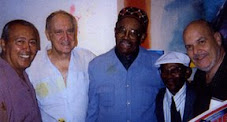
Vince, Robert Farris Thompson (r), and an admirer.
Note: Last year, Vince met for an interview with Robert Thompson, the distinguished Yale professor who is writing his highly anticipated history of mambo. A lively correspondence has ensued.
Below is an excerpt, discussing Vince’s early passion for Casino de la Playa’s classic “Bruca Manigua.” The first Arsenio Rodriguez tune ever recorded, “Bruca” was “a landmark in the development of Cuban popular music,” as Ned Sublette details in his book, Cuba and Its Music. Xavier Cugat had recorded the track within half a year of the Casino de la Playa original, and Vince was under its enduring spell in his teens.
RF Thompson:
26 December, 2008
One thing that amazes me about your career is how you picked up on “Bruca Manigua” back in 1939 and started playing it on harmonica. What pulled you into this song? Lyrical feel? Afro-Cuban savor? All of the above and more? What I want to know is how the lyrics hit you. They were in an intricate mixture of bozal (slave idiom in creolized Spanish) and creolized Ki-Kongo, flaunting words like fwiri and mundele. Beyond the Afro-Atlantic complexity, did you dig “Bruca” mainly because of the melody?
You had to be one of the hippest men in New York that year simply by virtue of playing that song on a harmonica. Been listening to Noro Morales’ mambo, “110th Street and Fifth Avenue,” and thinking of you boarding the bus in Washington Square and riding to the end of the line, right at the Park Plaza corner.
Have a brilliant New Year,
Bob
Part One:
“Bruca Manigua”
Indiambo congori, omelenko, la-di-o-de, coro mi yare—where do these sounds come from that they drown out the music and the culture I was born into? They forever forbid my disloyalty to them—they made me a religious person even though I knew nothing of their meaning. How did they capture me so gently, using their very concealed implications to control me?
From early childhood, as a special-education candidate due to lead poisoning that profoundly affected my hearing, my efforts to understand my world led me to become fascinated with the unknown—with what was escaping me in life. I sought shelter in the mysterious shadows that both hid me and comforted me as an adopted outcast. I grew up further and further from the path that others took. This attitude that was part of my formation set me aside from a society that I could handle easily as long as an odd quality and mystery remained a part of me. I neither belonged entirely to Africa or to America in the sense that my hearing evolved on a different level from normal—which in turn placed me astride a larger world that I balanced myself on like a circus bareback rider holding two galloping horses under his control, with one foot on each.
This effective bipolarity assisted rather than hindered my learning in that it demanded twice the effort—not to conform, but to understand, to balance my intellectual equilibrium. Thus, while I could not understand or speak Africa, I went on to conquer six languages of the Western world.
The sounds and vocabulary of Africa were the source eventually of a sweet mystery—the essential ingredient in the formation of an artist. This was even more induced in me since prior to the poisoning, my early teachers, as well as strangers, had used the word “genius” in my presence. There was, it was discovered, a musical genius who had died in childhood, my cousin who played piano sitting on phone books. Geneological investigation showed an above-normal number of family members engaged in the field of music. With no musical ability or training of my own, I had to satisfy myself with only the appreciation of what music was all about. Talented musicians could express it, interpret it, whereas I had to absorb it with no escape valve.
This esoteric burden manifested itself in the release I found in response, in the physical expression encompassed in dancing. Not American-style dancing or classical footwork, but in the dancing that is African. This came about guided by the music that I came in contact with. Initially, my family preferred opera to popular music but for me opera represented a musical establishment that at the same time jived with the everyday music.
When in 1936 and onward I caught bits of African music coming from abroad, from the islands and Cuba, I sensed that there was a jinni in what I was now hearing. New, unfamiliar sounds that sounded familiar to me even though I didn’t know why. The reason, I now understand, was the fact that, like language, they had to be listened to with a different part of me, one that evoked more than passing interest. They spoke to me in a seventh language, literally and figuratively, using the sounds of the drum that compelled me to follow more obediently.
The drum began to be something I needed biologically, it seemed. It filled the empty quality of deafness the way the gigantic Wurlitzer organ at the Paramount Theater filled the house. To the rafters.
Part Two:
“Bruca Manigua” and Mother
“El Manisero”… What is this manisero, this repetitious melody that is heard everywhere and where did it come from, everyone wondered back in 1937? “…un cucuruchu de mani…” What is a “cucuruchu”? By the time I learned that the song was what we today call a singing commercial, the “Peanut Vendor” passed on, only to be replaced by “La Cucaracha.” “Ya no puede caminar…,” another odd “Spanish” song, this one about a roach. When “La Cucaracha” crawled away, we were ready for a Latin tune called “Siboney” whose more sublime lyrics spoke plaintively of a black slave’s ordeal. Its melodic beauty was like a schoolgirl’s lament, lacking the basic ugliness of the horrors of slavery.
As “Spanish music” became more popular, we heard, for example, “El Plato Roto.” “Pancho tuvo que pagar / lo que rompio Rafael”…songs with sexual implications like double-entendre meanings wherein Pancho pays for what Rafael broke. El plato (plate, dish) and roto (broken) being a girl’s hymen. “El Bastidor” was another sly device, that sang of the hardness of a mattress as well as the durability of the male organ.
But these playful or sugary reflections did not have the blood and guts power of a song that spoke out the truth, loud and clear. They seemed to conceal, to hesitate or only hint at the slaves’ oppression. Just as the iron chains that restricted movement to just the four steps of la conga, there was no room in the lyrics to encourage rebellion, that is, until “Bruca Manigua. “Sin la libertad no puedo vivir / siempre tan maltrata”! This song touched and alerted a sensitive nerve that lay dormant in me, even having heard the sadness in the impoverished peanut vendor’s cry.
“Bruca” had sounded the key note and was followed soon by other brazen messages: “Yo Soy Karabali,” “Negro Nananboro,” Chano Pozo’s “Guaguina Yerabo,” Piniero’s “Yambo,” “Yambu” and “Lamento Borincano”… The ponderous quality of “Bruca” and the others, with all the drama that they exposed, still had more to follow even while holding me in vicarious empathy. Instead of doing my math, I played and replayed those records on my old phonograph, chained to it.
The full result of my original exposure and consequent entrancement with Afro-Latin music did not hit me until “Juan Fue Pa’ La Guerra,” with Daniel Santos singing “Quehago si vuelvo / y no encuentro a mi mama?”The composer was Pedro Flores. Here was a demoralizing song that ran counter to the US Army’s policy of allowing only militarized motivation for the sake of patriotic encouragement. This very touching song ended with the sad words, “What will I do should I return (from the war) and not find my mother (alive)?”
Since I was about to leave for the army, these sharp words were suddenly pertinent, more personal even those Miguelito Valdes sang in Arsenio Rodriguez’s “Bruca.” These words that included one’s mother hit home in two ways: the universal and the personal…the love that Latin sons in particular have for their mothers, and the son speaking not of his likely death in the army, but of his mother’s pain in not seeing her son again…his mother’s own dolorous ending…not his own pain over her death.
Such gut-wrenching lyrics exposed the quality of the culture that was behind the music. It being a sentimental blessing that produced such love, whether black or not.
This all surfaced and came together as a conscious awareness that I correlate with whenever I am in the physical presence of the people and their Afro-Latin music, or when alone with my conscience.
Among the ten top artistic directors and orchestral conductors is Daniel Barenboim, earning two million dollars a year, or should we say a season. In fact, these ten lucky individuals take in over ten million dollars in salaries! Not bad for a clique of sophisticated elitists in the symphonic and operatic establishments. Fundraising gala performances could use some housecleaning. Charity begins at home and should end in the street, where it will do the most good. To the people!
Are the complexities of Mahler’s Ninth Symphony any more challenging than a salsa montuno performed by Rene Lopez’s twelve-piece orchestra, where a close listener can catch experimental, classical, serial, modern and postmodern influences?
Music should serve to spread the maximum good the greatest audience. It should best be out of Lincoln Center’s grasp and out in the street for the people, by the people and of the people…a birthright. For every black tie fan attending the annual Mostly Mozart festival, a thousand Latinos are enjoying Marc Anthony’s latest hit.
A worldwide survey found Puerto Rico to be No. 1, the happiest place on earth. Is it because many poor families harbor at least one musician or more? More than an evening’s gala is present night and day in the Latin music that is in the air one breathes…out in the streets of P.R. It is not in the snooty confines of academic strongholds that are constantly begging for donations to stay alive while attendance dwindles. Is this not a good example of snobbism, where unknown names perform unknown opuses to a restricted, mostly tax-sheltered “select” audience?
When the average music teacher struggles to secure pupils that struggle to afford lessons themselves, this in itself restricts not only the appreciation of music but also its influence. Money should not only go into offering scholarships but also into making musical instruments available like library books to students who cannot afford to buy them, like giving them chances to learn how to fish, instead of giving a handout.
In an alley alongside a nightclub opposite El Capitolo in Havana once stood an old beat-up piano. It was placed there during the day and rolled out front at night where the Anacaona all-girl orchestra played on the sidewalk as people passed by. We could call it, today, a free concert. During the afternoon, anyone who wished to play that piano (while standing) could do so. Strangers would crowd around it and sing along as though they were fraternity boys joining in. They would continue singing as they left to continue their day. This is what music is really all about. It is our global anthem.
Even before the Great Depression of the 1930s, many hungry children in New York without supervision would eat their crayons, swallow white paste, chew tar like gum, and ingest lead paint for salt. It was this lead, not decibels, that damaged my hearing. However, this unfortunate handicap served to introduce me to the exquisite sounds of Latin music.
The vibrating chords of a solo organ playing “Siboney” awoke a withdrawn child. The penetrating sounds of this grand orchestral device came from thousands of miles away, from the Hotel Nacional in Havana. “Siboney,” the theme song of the Lecuona Cuban Boys, came in via shortwave radio, full of static, fading in and out, at times completely silent, clearer in summer than winter and very late at night. “Turn off that radio!” my dad would shout from the other room. Turning down the volume a wee bit, I would bring the radio under the sheets with me, married as it were, to the music. Next day, I would fall asleep in class.
Between my family’s understandable protests, the poor reception in the early days of radio, and my troubled hearing, I could only remain frustrated by this foreign music. These novel sounds were unknown in this country during the 1930s, except for one magical tune that was heard around the world: “El Manisero.” I became determined to someday track down this elusive, enticing music to its source.
Today, some seventy years later, I still bring my radio up to my ear by using earphones, and while my hearing has worsened, the technology has improved. In 1941, the composer of “Siboney” invited me into his dressing room. He sat down at a small piano and, looking directly into my eyes, began to play “Estas Siempre en Mi Corazon.” “You are the first one to hear this song,” he said. This is where the music has been all these years, I thought…always in my heart
From an Interview with Vincent Livelli by Judy Samuels
Vincent Livelli first “awoke from infancy” at 117 Sullivan Street in Greenwich Village.It was when his mother took him to the window to see his first snow. She picked up a handful of snow from the window sill and put it in his hand. She taught him about fire the same way, but much more gingerly.
In the 1920s, European immigration was at its peak.The Village social parlor was the streets, which were arenas of volatile class tensions as well as communal mixing. The South Villagers, though mostly all Italian, were deeply divided by region and class — the Genoese looked down on the Sicilians; the Sicilians resented Genoese business success and adaptability (They called them the Jews of Italy).Vincent’s Genoese family owned the building they lived in, and their landlordly position stung the Sicilian tenants’ sense of pride.
Walking to school at P.S. 102 on Varick Street, Vincent would be bullied by kids on the street and sometimes spat on from a tenant’s window.He escaped this fate when he walked to Central Park with his older cousin Jimmy.Jimmy worked in the paper box industry in the manufacturing district now called Soho.Sometimes he carried his younger cousin on his shoulders.In Central Park, they would go skating on the frozen lake.
Vincent remembers, as do some of us, when the Jefferson Market Library, back then the Jefferson Market Courthouse, was of a piece with the Women’s House of Detention.The inmates would yell down through the barred windows to the street and throw messages to friends on Sixth Avenue.Around 1974, the Women’s House of “D” was torn down.Today its memory is blanketed under lush flowering plants in a lovingly-tended neighborhood garden.
Vincent was born in Brooklyn and at six months old moved to 117 Sullivan Street, which he shared with his mother, father, grandparents, Aunt Tessie and unmarried Uncle John.Just across the street was the stable where the teamsters’ horses were bedded down.Their carts were parked in the street right outside his window.Before there was window screening, flies from the horses would invade his room.He could look out his window on hot summer days and see the horses returning home tired from pulling the beer wagons through the city streets.He watched as they climbed slowly up the incline to their stalls, and as the impatient teamsters beat them to hurry them up.The misery of the overworked horses came through the window with the breeze that carried the smells of hay and horse urine. At three years old, Vincent saw policemen shoot horses that were foaming at the mouth from exhaustion.He saw them drag the bodies through the streets.
When excavation work began on the Sixth Avenue Subway, Vincent played in the mountains of sand that piled up.He lit the gas lamps in the hallways of 117, held aloft on his grandfather’s shoulders.The building had two communal toilets on each floor — the pull-chain kind — that served three families.The coolest places in the building, in summer they were a popular escape from the stifling apartments.
In the twenties, poisoning from lead paint didn’t recognize class differences.Many children suffered the effects of eating the flaked-off paint chips from apartment walls.
Vincent, despite being affected with permanent severe hearing loss, learned four languages, andlearned to dance and love Latin music from his Sicilian mother.For his first lesson, she climbed up on the kitchen table and danced. She told him stories about the Black Cat, the cabaret on West Third Street, and Mori’s Restaurant on West Fourth, popular in the 40s, that had a fountain in its inner courtyard.But the San Remo Bar Vincent discovered on his own.
Located on the corner of Bleecker and MacDougal Streets in the heart of Italian Greenwich Village, it became home to the“Village nobility” of the1940s and ‘50s.Anatole Broyard, who Vincent met at Brooklyn College, was at the center of a literary circle that included French diarist Anaïs Nin, poet Delmore Schwartz, writers Milton Klonsky and William Gaddis, and other artists and writers.
At Brooklyn College, Vincent was an outsider among the mostly Jewish, staunchly Leftist crowd.Anatole Broyard, the son of a New Orleans carpenter and a light-skinned black man, was equally set apart.They became close friends for the rest of their lives.Though neither of his parents had finished elementary school, their son became a writer and a book critic for the New York Times.In 1938, the two got an apartment together on West Third Street where the rent was ten dollars a month.In 1945, they opened a bookstore at 18 Cornelia Street, which became a literary nucleus in the Village, a favorite hangout for Maya Deren, the high priestess of experimental cinema, and writer Terry Southern, among others.Anatole’s Greenwich Village memoir, Kafka was the Rage, ignited an interest in European literature.
In 1948, after serving in the army in World War II, a cold day job-seeking on Wall Street made Vincent dive into a steamship office to warm up.Destiny must have had a hand because the world suddenly opened up with that steamship office, and, instead of Wall Street, he picked up a job as cruise director on a ship to the Caribbean, a career which would take him to sixty-five countries.Back in New York City, in the midst of the Depression he learned Latin dance at the Park Plaza on 110th Street off Fifth Avenue, where poor Puerto Rican and Cuban families went to reclaim their lost cultures.
In a letter to Anatole’s daughter, Bliss, Vincent told her how her father had “refereed a certain decorum” when engaged in heated literary discussions with others at the San Remo Bar.“Nimble with words, his sentences skipped along, churning the air with words never heard before. . . . “Tempers raged in this bar atmosphere as people argued their literary opinions.“There were days when they would cross the street to avoid each other because of Proust.”
Late in the 1940s and into the ‘50s, the elegant iron grillwork began to disappear from many Village balconies.NYU began its expansion, and with it the historic streets of the Village were rearranged or broken up.For Vincent this was the time “Anaïs Nin opened her diaries [to the world], Sartre’s ‘Huit-Clos’ opened on Broadway, and the Mob controlled Saints’ Days.”The intimate romance of the Village was disappearing.
The building at 117 Sullivan Street is today a condominium.An apartment in this buildingwith no super rents for $1,300 a month.Vincent Livelli spent the decades of the sixties and seventies traveling the world on cruise ships, a Latin-music missionary.“Is it not better,” he wrote to Bliss, “to follow the way of the self-forgiving solitary traveler?”
Vincent and Anatole were sharers in the post-World War II Village where friendship and love were bound together by love of poetry and literature.“Everyone was writing.” One afternoon, Vincent met James Baldwin coming out of the bar at the Carlton in Cannes, France.“He gave me his number, and when I called, he said he would do a portrait of me, in the style of Matisse or Van Gogh.He once sang for me to keep the cold at bay in his wind-swept loft.”
In 1954, Anatole’s first published story, “What the Cystoscope Said,” gained him status in the world beyond the Village, but strangely prefigured his death from cancer years later in 1990.From his experience as a patient, he wrote the collection of stories Intoxicated by My Illness; it was Anatole’s posthumous gift to the world.In it, he gave a literary voice to illness, suffering, sex, and death. "I’m not interested in the irony of my position,” he wrote. “Cancer cures you of irony. Perhaps my irony was in my prostate.”
Vincent, who “walks the Village with his friend’s ghost, knows this is where his heart still resides, among the landscapes of our happy youth.Thus, we are joined together not in sadness but in the feeling that we were so close to a miracle that we could have saved the world.”
Vincent Livelli, far right, in 1948 at the Embassy Club, Plaza San Martin, Buenos Aires
Unless one arrives in a foreign country with letters of introduction, it is necessary to form new friendships and new experiences on your own.
In 1948, I showed up in Buenos Aires with plenty of friends whom I had met aboard the SS Argentina. Furthermore, these new friends were all high society. For example, Luiz Herrera, the world polo champion and race-car driver, who was the Maradona of his day, when polo was what soccer is today in Argentina. Also Samuel Jankelovitch, Evita’s impresario, and the Urquiza family, like our Kennedy clan. These folks met me at the dock in their Cadillacs when I would return to Buenos Aires, at a time when importing foreign cars was illegal. It was also a time when, since the British had built the nation’s railroads, the sight of British tweed jackets, cravats and English Leather cologne was in evidence everywhere. Within this circle of companions, in a hospitable country, I felt comfortably ensconced…that is, until I recently read the bookTango: The Art History of Love, by Robert Farris Thompson.
Where I had always received a warm Buenos Aires welcome, had I arrived cold, my present memories of those days would be quite different.
I was hanging out with the wrong crowd, listening to white (chongo) tangos of Carlos Gardel and frequenting clubs with the aristocratic atmosphere of the 1940s tango del salon. Forever in the upper-crust company of politicos and shifty club owners, I stayed at fancy hotels such as the Plaza, across from the Embassy Club on Plaza San Martin, owned by a Señor Kootcher. His elegant club was where we danced and dined, dressed tenue de soiree, on my nightclub tour of Buenos Aires that included a stop at the La Querencia club for some gaucho entertainment (malambo zapateado) and ending at the Gong for Americanized Argentine jazz. After the tour, I would finish off the evening at Cabaret Tabaris. This club was balconied and had a telephone at each table, which allowed you to connect with attractive unescorted ladies—and idea borrowed from European clubs.
Until I read Prof. Thompson’s Tango, I was unaware that there was another Argentina, where tango is to its citizens what rumba is to Cubans. During the time I lived in Havana, Cuban society was already beginning to more openly accept Afro-Cuban talent, whereas Argentina during that era of more British-influenced mores, was hiding the African origins of its national dance—its beating heart.
True, there were districts in Buenos Aires that were equivalent to the solares, patios and bateys of Havana, but I never knew of them. Never did I see Afro-influenced canyengue tango, where the male partner’s knees are bent with his torso pushed forward (this style is similar to Killer Joe’s hot rumba as he showed it to us at the Palladium). Nor did I enjoy black malambo, a dance of ritual purification that, like teeza maza, features explicit foot stomping as part of the tango. I never knew the ki-kongo power that drives the tango. I would not have feared entering the La Boca district, the city’s inner port with its bars and brothels, where tango was born.
Like being in love, faithful to one woman all my life, I only knew Afro-Cuban cultures, until I read that tango was born of the same mother: Mother Africa. Now my vocabulary includes yumba (“God’s command”), mufa (“bad luck”), mayembo (“trembling shoulders”) and other words added to my Afro-Cuban abrecuto quri dinga and babarabatibi coibi, etc.
Where I easily found Africa in Belize, not to mention Haiti or Boriqua, I feel I was cheated of memories that would today take me, like those I have of Cuba, to darkest Africa—the darker and hotter, the better.
Havana in 1941 was one of the gayest cities on earth. With pristine beaches, lively music, tobacco, rum and beautiful women in abundance, it was a tropical paradise in the sun. Who could choose a better location to wait out the war in Europe?
In the upper-class sector of Havana, Vedado, about thirty families were living, not as Cuban refugees, but Jewish refugees. They had managed to escape the Nazi persecution but they lived from day to day in despair, with no means of support other than donations from Jewish charities. Many had endangered relatives in Europe. With little chance of returning to the ruins of their former homes, they survived as best they could. Not permitted to hold jobs in Cuba, they were desperate people.
Among the professionals, artists and businessmen, were many tailors whose wives took needle and thread in hand and made neckties for sale. During the Great Depression, this strategy had earned poverty stricken Jewish families money for food. The gift of a necktie for father at Christmastime arose then, during the birthdays and holidays, as a result of this activity.
Since Christmastime encouraged the greater display of decoration, these Christmas ties enlivened the male wardrobe, adding cheer to a sad time in America, and helped to break the somber style of dress in general in America.
In Cuba, however, the tropical climate and the absence of air-conditioning meant a need for loose clothing. An example is found in the typical Cubavera, a shirt with an unbuttoned neckline and no tuck-in at the waist. Even today, neckties are being abandoned in greater numbers around the world.*
When the Jewish refugees saw me passing by daily, they became more and more curious, and more suspicious of me. Could I also be a refugee, they wondered? I was approached by the salesman one afternoon, who had at last spotted a likely customer. Here was a gentleman who actually was wearing a tie in Havana!
It was an easy sale. I bought a tie since I could not only use one, but because the price was cheap. Besides, it was practical souvenir of Cuba to take with me when I returned home, to remind me of those who had lost theirs.
Born in 1920 in Brooklyn, New York, Vincent Livelli has been a lifelong Latin music enthusiast. In his quest to bring salsa to the masses, Vince has made his archives available to the public. They reflect on the power of the music as well as Vince's first-hand accounts from Cuba, aboard dozens of cruise ships, and in ports around the world.
 While dancing with a partner, Electrico was one of many, but as couples left the floor, including his partner, he went into a solo as the band continued playing, now for him alone. We soon saw that we were in the presence of greatness. Here was something stunning, like Mike Tyson's debut in the boxing world. He would arrive and leave alone. No one embraced or approached him, respecting his stature with distance, as we did on the dancefloor proper. A low key modesty characterized his social behavior. Only the musicians, the drummers in particular, were seen close to him. Respect was more appropriate than celebrity. In 1938, dancers dressed in a serious fashion, with jackets and tires and gray suites (except for Midnight's black suit and vest). The scene at the Park Plaza was incongruous with raw African moves dressed in Western garb. His partner was the seated drummer more than una Latina. They were working rather than performing, as we tried to catch their smallest gestures.


.JPG)